Horizontal Slope Guide
The Diagnosis: Understanding Horizontal Slope in Drainage Systems
In drainage plumbing, horizontal slope—often called pitch or fall—is the engineered grade given to a pipe to ensure waste and water flow via gravity to the sewer or septic tank. An incorrect slope is a primary cause of chronic clogging, slow drains, and sediment buildup. This guide details the precise minimum pitch requirements for pipes under and over 3 inches, the hydraulic principles of pipe velocity, and the code-compliant methods to achieve reliable, self-scouring drainage lines.
Technical Deep Dive: Calculating and Installing Correct Pitch
Slope is expressed as a vertical drop per unit of horizontal run (e.g., 1/4 inch per foot). The goal is to achieve a flow velocity between 2 feet per second (fps) and 10 fps—fast enough to carry solids, but slow enough to prevent siphoning of trap seals.
Step-by-Step Installation Protocol
- 1. Determine Pipe Size and Fixture Units: Calculate the total drainage fixture units (DFUs) the branch or main will serve. This load dictates the minimum pipe diameter, which in turn dictates the minimum slope.
- 2. Set the Minimum Pitch: Per the International Plumbing Code (IPC) and Uniform Plumbing Code (UPC), the standards are:
- For Pipe Sizes Less Than 3 Inches: Minimum slope is 1/4 inch per foot (2% grade).
- For Pipe Sizes 3 Inches and Larger: Minimum slope is 1/8 inch per foot (1% grade).
- 3. Calculate Total Drop: For a 20-foot run of 2-inch pipe: 20 ft. x 1/4 in./ft. = 5 inches of total drop from start to end.
- 4. Establish Grade: Use a laser level (e.g., Milwaukee RedLithium) or a quality line level and mason’s line to set a reference string at the correct grade. For critical long runs, a transit or optical level provides professional accuracy.
- 5. Support and Test: Install pipe hangers or supports per code spacing (every 4 feet for 1.5-2 inch pipe). Before final cover-up, perform a water test or air test to check for leaks and observe flow.
The Hydraulics: Pipe Velocity and Clogging
The relationship between slope, diameter, and pipe velocity is critical. Velocity (V) is calculated using the Manning formula, where a steeper slope increases velocity. However, excessive slope (more than what’s needed for 10 fps) causes liquids to outrun solids, leaving waste behind to cause clogging. Conversely, insufficient slope results in velocities below 2 fps, allowing solids to settle. The code-mandated minimums are engineered to keep velocity in the optimal 2-10 fps “self-scouring” range for typical waste loads.
| Pipe Diameter (inches) | IPC/UPC Min. Slope (in./ft.) | Typical Max. Fixture Units | Target Velocity Range (fps) |
|---|---|---|---|
| 1.5 | 1/4″ | 3 DFU | 2.5 – 8 |
| 2 | 1/4″ | 6 DFU | 2.2 – 9 |
| 3 | 1/8″ | 20 DFU | 2.0 – 10 |
| 4 | 1/8″ | 160 DFU | 2.0 – 10 |
Code & Compliance: Adhering to Plumbing Standards
Plumbing codes are not suggestions; they are the legal minimum for a safe, functional system. The IPC Chapter 7 and UPC Chapter 7 govern the installation of sanitary drainage. Key citations include:
- IPC 704.1 / UPC 704.1: “Drainage piping shall be installed with a uniform slope and alignment…” This prohibits sagging or reverse grade.
- IPC 704.1 & Table 704.1: Explicitly lists the minimum slopes for all pipe sizes, as detailed in the table above.
- OSHA 1926.651(b): For trenching work, requires protection from cave-ins when excavating for sewer lines, emphasizing jobsite safety during installation.
Always verify amendments with your local Authority Having Jurisdiction (AHJ), as local codes can be more restrictive.
⚠️ Safety Warning
Before cutting into any existing drainage line, ensure the system is not under pressure and that all upstream fixtures are shut off. When working in trenches deeper than 4 feet, OSHA requires a protective system (sloping, shoring, or a trench box). Always use proper PPE—safety glasses, gloves, and hearing protection when operating power tools.
Toolbox: Essential Gear for Precision Slope Work
- Grade Setting: Rotary Laser Level (e.g., Milwaukee M12 RedLithium), 48″ I-Beam Level, Mason’s Line, Line Level.
- Measurement & Layout: 25′ Tape Measure (e.g., Ridgid), Digital Angle Finder, Chalk Line.
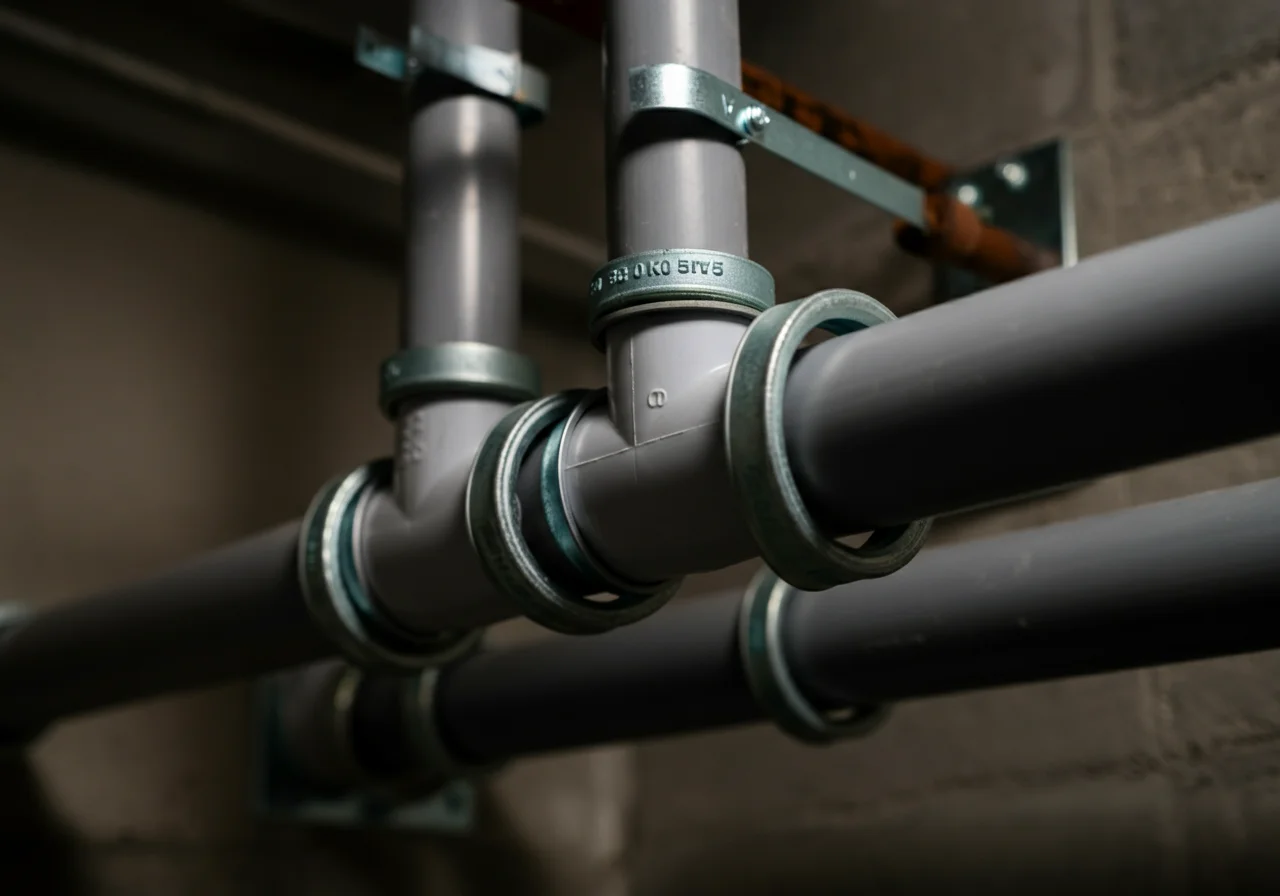
- Pipe Cutting & Joining: Power Cutter (e.g., Ridgid 222), PVC Saw, Appropriate Primer & Cement.
- Testing: Air Test Kit or Water Test Plugs, Fluke digital manometer for precise pressure testing.
External References for Further Study
For the definitive engineering principles behind drainage design, consult the Uniform Plumbing Code published by IAPMO. For a foundational understanding of open-channel flow hydraulics relevant to pipe velocity, the Wikipedia entry on the Manning formula provides a detailed technical explanation.
Advanced Considerations: Beyond Minimum Slope
While meeting code minimums is mandatory, optimal system design often requires analysis beyond the basics.
- Long Horizontal Runs: For branches exceeding 50 feet, consider increasing the slope slightly (e.g., from 1/4″ to 3/8″ per foot for a 2-inch line) to compensate for friction loss and maintain terminal velocity.
- Grease and Waste Lines: Lines from commercial kitchens (grease) or washing equipment (lint) are prone to specific clogging. IPC 1003.3 mandates that grease interceptors be installed with a specific access and slope. For these applications, a 1/4″ per foot slope is an absolute minimum, and more frequent cleanouts are required.
- Testing for Adequacy: After installation, a simple functional test is to run a full basin of water from the farthest fixture. It should drain completely and quickly, with no visible standing water left in the pipe when viewed through a cleanout.
Mastering horizontal slope is a fundamental skill that separates functional, low-maintenance drainage systems from problematic ones. By adhering to the prescribed pitch for pipe sizes relative to 3 inches, understanding the role of pipe velocity, and proactively designing to prevent clogging, you ensure a system that performs reliably for its entire service life.