Backflow Preventer Types
The Diagnosis: Selecting the Correct Backflow Prevention Assembly
Choosing the correct backflow preventer type is a non-negotiable requirement for protecting potable water supplies from contamination due to backpressure or backsiphonage. The selection is dictated by the degree of hazard—the potential health risk posed by the cross-connection. This guide provides a technical breakdown of Atmospheric Vacuum Breakers (AVB), Pressure Vacuum Breakers (PVB), and Reduced Pressure Zone (RPZ) assemblies, their applications, and the code mandates that govern their use.
Technical Deep Dive: Assembly Types, Operation, and Installation
The fundamental principle of backflow prevention is creating a physical air gap or a series of check valves to prevent reverse flow. The assembly’s complexity increases with the level of protection required.
1. Atmospheric Vacuum Breaker (AVB)
An AVB is a non-pressure-type, mechanical backflow preventer containing a float-check, an air inlet vent, and a poppet valve. It operates solely on the principle of atmospheric pressure and is effective only against backsiphonage, not backpressure.
- Operation: Under normal flow, water pressure lifts the poppet, allowing water to pass. When flow stops or a vacuum occurs, the poppet drops and the air inlet vent opens, breaking the suction and preventing backsiphonage.
- Key Installation Mandates (UPC 603.5.2):
- Must be installed at least 6 inches above the highest point of downstream usage (the critical “6-inch rule”).
- Cannot be under continuous pressure for more than 12 hours in any 24-hour period.
- No shut-off valves are permitted downstream of the device.
- Typical Applications: Laboratory faucets, hose bibbs (with approved model), irrigation system branches with no chemical injection.
2. Pressure Vacuum Breaker (PVB)
A PVB is an improved vacuum breaker designed to operate under continuous system pressure. Like the AVB, it protects against backsiphonage only.
- Operation: Incorporates a spring-loaded check valve and an independently acting, spring-loaded air inlet valve. The air inlet valve is forced closed during normal flow by water pressure. If pressure drops to 1 PSI, the air inlet opens to admit atmosphere.
- Key Installation Mandates (UPC 603.5.3):
- Must be installed at least 12 inches above the highest point of downstream usage.
- Can be under continuous pressure.
- Includes test cocks for annual performance verification.
- Typical Applications: Mainline protection for lawn irrigation systems, industrial cooling towers (non-chemical), and other low-hazard, continuous pressure applications.
3. Reduced Pressure Zone Assembly (RPZ or RPZA)
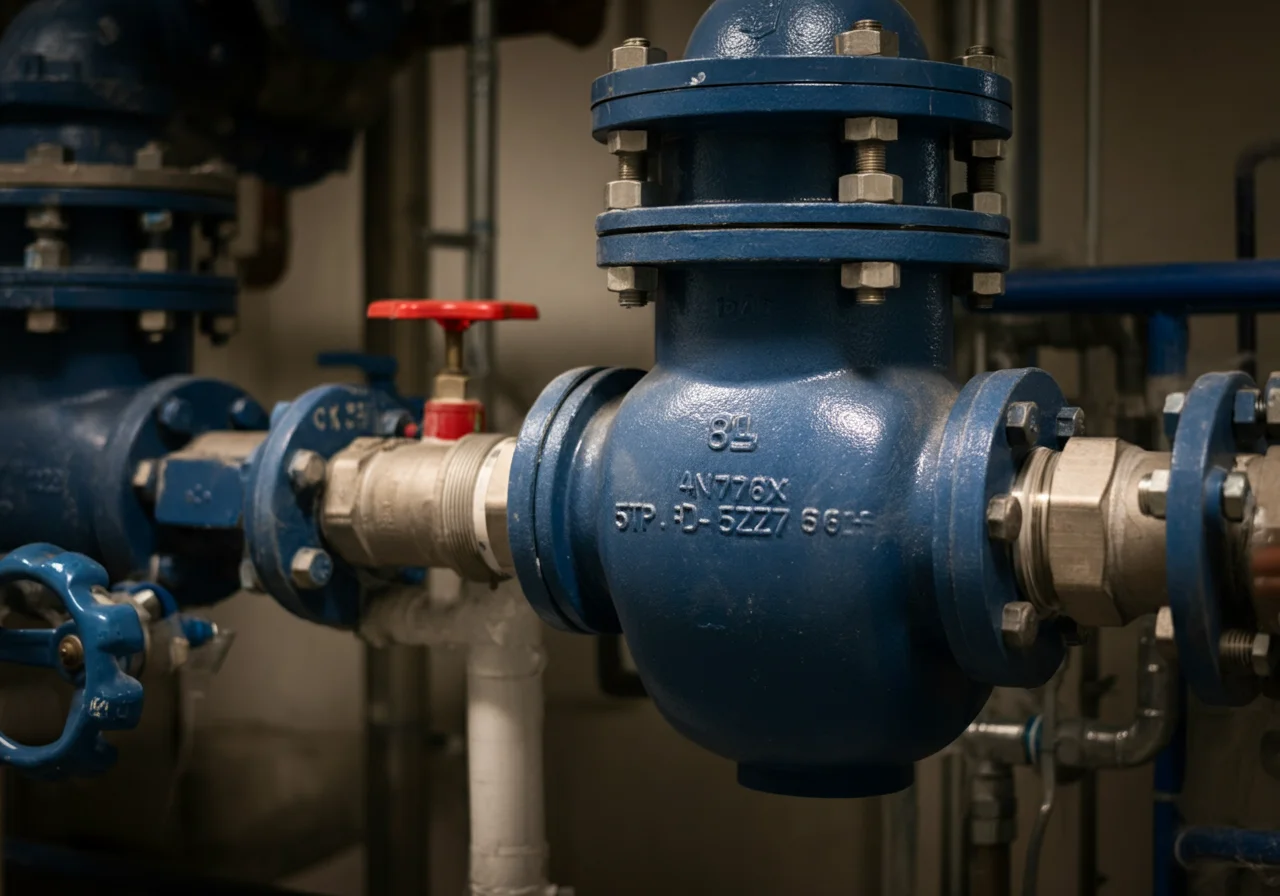
The RPZ valve is the highest level of mechanical backflow protection available. It provides protection against both backsiphonage and backpressure and is required for high-hazard cross-connections.
- Operation: Features two independently acting, spring-loaded check valves with a hydraulically operated, mechanically independent relief valve located between them. This creates a “zone of reduced pressure” between the checks. If either check valve leaks, the relief valve will discharge water to the atmosphere, maintaining the pressure in the zone lower than the supply pressure.
- Key Installation Mandates (UPC 603.5.5):
- Must be installed in a location where discharge from the relief valve will not cause damage; typically requires an air gap drain.
- Must be installed above grade, in a heated space, or in an insulated enclosure to prevent freezing.
- Requires annual testing and certification by a licensed backflow technician.
- Typical Applications: Boiler feed lines, industrial process lines with chemicals, medical/dental equipment, fire sprinkler systems with antifreeze, and any connection to a potable system that contains a contaminant.
| Assembly Type | Protects Against | Degree of Hazard | Key Limitation | Annual Test Required? |
|---|---|---|---|---|
| Atmospheric Vacuum Breaker (AVB) | Backsiphonage Only | Low (Pollutant) | Cannot be under continuous pressure | No* |
| Pressure Vacuum Breaker (PVB) | Backsiphonage Only | Low to Moderate (Pollutant) | Cannot protect against backpressure | Yes |
| Reduced Pressure Zone (RPZ) | Backsiphonage & Backpressure | High (Contaminant) | Requires drain for discharge; most expensive | Yes |
*AVBs require periodic inspection but not formal pressure testing with gauges.
Code & Compliance: The Legal Framework
Selection is not a matter of preference but of law. The International Plumbing Code (IPC) and Uniform Plumbing Code (UPC) define cross-connections and mandate protection levels.
- IPC 608.1 / UPC 603.2: Requires the installation of approved backflow prevention assemblies as required by the degree of hazard.
- Degree of Hazard Definitions:
- Contaminant (High Hazard): A substance that, if introduced, would cause illness or death. Requires an RPZ or an air gap.
- Pollutant (Low Hazard): A substance that would degrade water quality but not pose a direct health threat. May be protected by a vacuum breaker (AVB/PVB).
- Local Authority: Always consult with your local water purveyor or building department. They have final authority and often maintain a list of approved models.
⚠️ Safety Warning
Before installing, servicing, or testing any backflow preventer, you MUST shut off the main water supply and relieve all downstream pressure. For RPZ testing or repair, be aware that the relief valve may discharge unexpectedly. Always wear appropriate PPE, including safety glasses. Failure to isolate the system can result in flooding, property damage, or personal injury.
Toolbox: Essential Gear for Installation & Testing
- For Installation: A professional-grade pipe wrench (e.g., Ridgid Aluminum Pipe Wrench) and a torque-limiting wrench for proper assembly connection per manufacturer specs are essential.
- For Testing & Diagnosis: A calibrated Fluke PG3 Hydraulic Pressure Gauge Kit or equivalent is mandatory for performing the differential pressure tests required on PVB and RPZ assemblies. Never rely on uncalibrated equipment.
- General Tools: Tube cutters, deburring tool, thread sealant (approved for potable water), and a multimeter for verifying electrical continuity on solenoid valves in integrated systems.
External Reference
For definitive technical specifications, installation diagrams, and maintenance procedures, always refer to the manufacturer’s installation manual for your specific model. Additionally, the foundational principles of cross-connection control are detailed by the U.S. Environmental Protection Agency (EPA), which oversees the Safe Drinking Water Act.