Sanitary Tee Restrictions
The Diagnosis: A Critical Code Violation
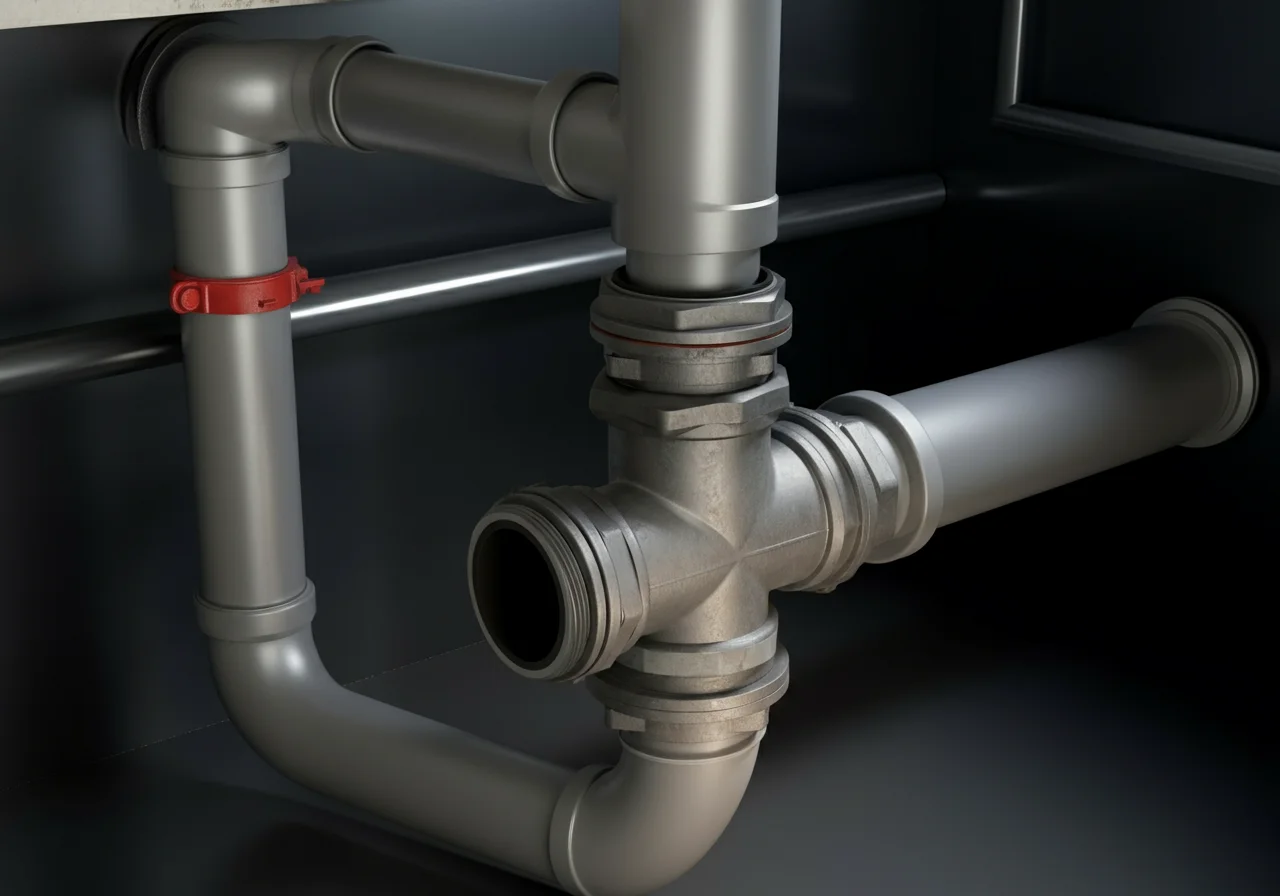
In drainage and vent (DWV) systems, a sanitary tee is a specialized fitting with a curved, directional branch designed to maintain flow efficiency and prevent solids from backing up into the vent line. Its usage is strictly governed by plumbing codes, with one of the most common and critical violations being its improper installation on its back for horizontal-to-horizontal connections. This misapplication creates a severe restriction that guarantees future clogging and system failure.
Technical Deep Dive: The Physics of Flow and Fitting Orientation
A sanitary tee’s design is not arbitrary. The curved branch, when oriented correctly, guides waste in the direction of flow with minimal turbulence. Installing it incorrectly disrupts this fundamental hydraulic principle.
Why Horizontal-to-Horizontal is Prohibited
When a sanitary tee is laid on its back (with the side inlet horizontal and the main run horizontal), it creates an immediate, sharp dam within the pipe.
- Flow Interruption: Wastewater and solids must make a 90-degree upward turn against gravity to enter the main run, which they cannot do. This causes immediate backup at the inlet.
- Solids Accumulation: Paper and solids impact the dam-like weir of the fitting, stopping dead. They cannot be swept away by the main flow, which passes beneath the opening.
- Guaranteed Clog: This configuration acts as a sediment trap. Each use adds material until a complete blockage forms, often requiring wall or ceiling demolition for access.
Correct Application: Vertical-to-Horizontal Transitions
The sanctioned and primary vertical to horizontal application of a sanitary tee is for connecting a vertical drain line (like from a toilet or sink stack) to a horizontal branch drain. Here, the fitting’s curve correctly directs waste from the vertical drop into the horizontal flow with a sweeping, guiding action.
- Step 1: Identify Flow Direction. Determine the direction of flow in the horizontal drain line.
- Step 2: Orient the Fitting. The straight, main run of the tee must align with the horizontal drain. The curved branch must point upward, connecting to the vertical pipe.
- Step 3: Maintain Grade. Ensure the horizontal drain maintains a consistent, code-specified slope (typically 1/4″ per foot for 2″ and larger pipes) away from the tee.
Toolbox: Essential Tools for Proper Installation
- Level: A high-quality torpedo level (e.g., Milwaukee) is non-negotiable for setting and verifying pipe slope.
- Saw and Deburring Tool: For cutting pipe square and removing internal burrs that can catch debris. A Ridgid tubing cutter provides clean cuts on plastic pipe.
- Multimeter (for related electrical safety): Before drilling or cutting near boxes, verify circuits are dead with a trusted brand like Fluke.
Code & Compliance: The Legal Backbone
Plumbing codes exist to ensure safety, health, and system longevity. The restriction against misusing sanitary tees is explicit.
| Code | Section | Relevant Text (Paraphrased) | Implication |
|---|---|---|---|
| International Plumbing Code (IPC) | 706.3 & 707.4 | Sanitary tees shall not be used where the direction of flow from the branch is from the horizontal to the vertical. Changes in direction of flow shall be made by fittings with a sweep of not less than 90 degrees. | Directly prohibits the horizontal-to-horizontal “on its back” installation. Mandates use of a combination wye and 1/8 bend or a long-turn tee for horizontal changes. |
| Uniform Plumbing Code (UPC) | 706.2 | Fittings shall be installed to direct drainage in the direction of flow. Sanitary tees are permitted for connections between horizontal drains and vertical drains. | Reinforces the directional flow rule and limits sanitary tees to vertical-to-horizontal connections only. |
| OSHA (29 CFR 1926) | Subpart P – Excavations | Requirements for trench safety during main line installation. | While not about the tee itself, compliance is required for any underground work accessing or installing horizontal drains. |
Correct Fitting Selection Table
| Application | Correct Fitting | Incorrect Fitting | Reason |
|---|---|---|---|
| Horizontal Drain to Horizontal Drain (90° change) | Long-Turn 90° Elbow (1/4 bend) or Two 45° Elbows | Sanitary Tee on its back | Provides a sweeping turn that maintains flow velocity and prevents solids from settling. |
| Horizontal Drain to Horizontal Drain (with branch) | Combination Wye and 1/8 Bend (Combo Tee) | Sanitary Tee on its back | The wye’s gradual angle allows branch flow to merge smoothly with the main flow. |
| Vertical Drain to Horizontal Drain | Sanitary Tee or Combo Tee | Standard 90° Elbow | The sanitary tee’s curve properly directs flow from vertical drop into horizontal run. |
⚠️ Safety & Best Practice Warning
Always shut off the main water supply and release pressure before cutting into any existing water line. When working on drainage, assume lines contain hazardous waste (H2S gas, pathogens) and use appropriate PPE—gloves, eye protection, and a respirator if cutting into old lines. Failure to install fittings per code can lead to raw sewage backups causing extensive property damage and health hazards.
External Reference for Technical Definitions
For a foundational understanding of drainage system components and principles, the Wikipedia entry on Drain-Waste-Vent Systems provides a reliable overview of system architecture, including the role of various fittings.
Conclusion: Adherence is Non-Negotiable
The restriction on sanitary tee usage for horizontal-to-horizontal drainage is not a suggestion—it is a mandate based on fluid dynamics and decades of field experience. Using a sanitary tee on its back is a guaranteed path to chronic clogging, service calls, and costly repairs. For any change in direction within a horizontal plane, the correct tool is a combination wye and 1/8 bend or a long-turn elbow. For the proper vertical to horizontal transition, the sanitary tee remains the fitting of choice. Knowing and applying these distinctions is what separates a professional, code-compliant installation from a failed system.