Sewer Camera Locator
The Diagnosis: Locating the Camera Head in the Line
A Sewer Camera Locator is an electronic system used to pinpoint the exact above-ground position and depth of a sewer inspection camera head (or other equipment) within an underground pipe. This is critical for diagnosing blockages, identifying lateral connections, and mapping pipe infrastructure without excavation. The core components are the camera’s integrated transmitter (a sonde) and a handheld receiver used for line tracing. The effectiveness of the entire system is heavily dependent on the push rod technology—rigid vs. flexible—used to advance the camera.
Technical Deep Dive: System Components & Operation
Successful location requires understanding the interaction between the camera push rod, the sonde, and the receiver.
1. Push Rod Selection: Rigid vs. Flexible
The rod is the mechanical backbone that transports the camera. Your choice directly impacts locating success.
- Rigid Push Rods (Fiberglass or Steel):
- Application: Best for straight-line pushes in clean, unobstructed pipes. Common in main line inspections from a cleanout.
- Advantage: Superior pushability and torque transmission for rotating the camera head. Provides a more stable, predictable path for accurate above-ground tracing.
- Limitation: Cannot navigate tight bends (especially 90-degree service bends) and can be difficult to retrieve if a blockage is encountered.
- Flexible Push Rods (Often with a steel core):
- Application: Essential for navigating residential sewer laterals from a roof vent or through house traps, which contain multiple bends.
- Advantage: Can traverse multiple 90-degree bends. Generally easier to retract if a blockage is hit.
- Limitation: Can “whip” or buckle in larger pipes, making the camera head orientation and location less predictable. Requires more skill to push long distances.
Pro Technique: For a full main and lateral inspection, a combo kit with both rod types is ideal. Start with flexible rods to navigate from the house to the main, then switch to rigid rods for the long, straight main line run.
2. The Sonde (Transmitter)
The sonde is a waterproof, cylindrical transmitter housed within or directly behind the camera head. It emits a specific radio frequency (e.g., 512 Hz, 33 kHz).
- Function: Acts as an electronic beacon. Its signal strength and orientation are detected by the handheld receiver.
- Key Specs: Depth rating (IP68 standard), frequency, and battery life. A dual-frequency sonde (e.g., 512 Hz/33 kHz) offers versatility for both deep and shallow locates.
- Orientation: The sonde is directional. Most are designed to signal strongest from their “nose” or “tail,” which helps determine if the camera is facing you or away.
3. Line Tracing with the Handheld Receiver
This is the active locating process. The operator walks the suspected pipe path above ground.
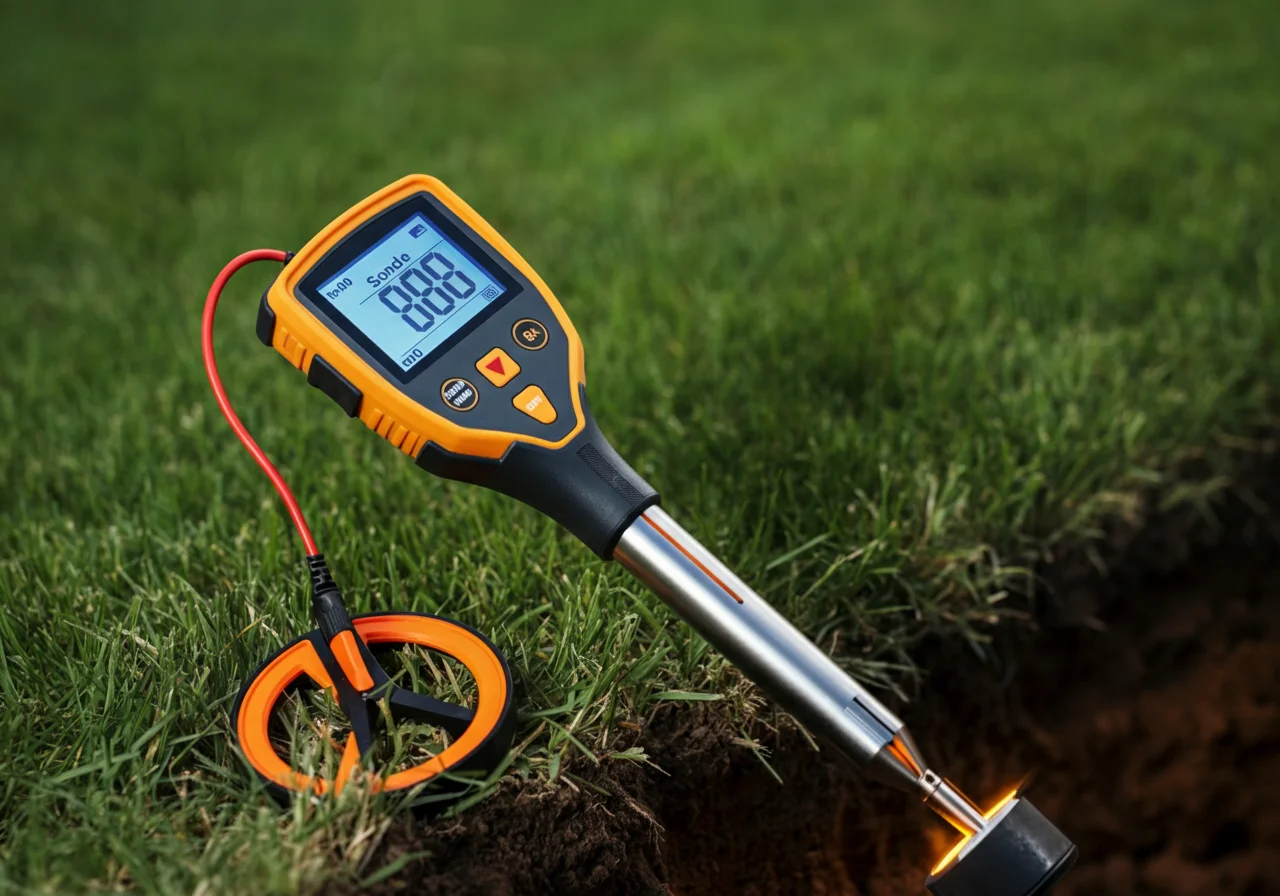
- Peak Mode: The receiver displays a signal strength bar. The peak signal (highest number) is directly over the sonde.
- Null Mode: The signal drops to a minimum when the receiver is directly over the sonde. Used to confirm the peak locate.
- Depth Reading: Quality locators calculate depth by measuring the signal field’s shape. For accuracy, hold the receiver perpendicular to the ground at the peak signal point.
- Current Induction: For tracing a non-transmitting line, some receivers can induce a signal onto a metallic rod or pipe, allowing you to trace its path.
Code & Compliance
While sewer camera locating itself isn’t directly code-mandated, the inspections it enables are governed by strict standards for repair and replacement.
- IPC/UPC Chapter 7 – Sanitary Drainage: Inspections verify compliance with requirements for pipe grade (IPC 704.1, UPC 704.1), cleanout placement (IPC 708, UPC 708), and joint integrity. Accurate location of defects is necessary for the proper scope of repair.
- OSHA 29 CFR 1926.651 – Excavations: Before any digging, you must determine the estimated location of utilities. A sewer camera locator provides precise data to meet this requirement for the sewer line itself, helping to plan safe excavation zones.
- NESC (National Electrical Safety Code): Critical when locating near power lines. Always Call 811 before any excavation. The sewer locator is for your specific line; 811 marks public utilities.
Toolbox: Essential Gear for Professional Locating
Reliable tools are non-negotiable for repeatable, accurate results.
| Tool Category | Purpose | Professional-Grade Example |
|---|---|---|
| Locator/Receiver | Pinpoints sonde location and depth | Ridgid® SeekTech SR-60 or equivalent multi-frequency locator |
| Inspection Camera with Sonde | Visual inspection and signal transmission | System with a dual-frequency, high-output sonde (e.g., 33 kHz / 512 Hz) |
| Push Rods | Camera deployment | Rigid fiberglass rods (for mains) and flexible steel-core rods (for laterals) |
| Multimeter | Diagnosing sonde/receiver power issues | Fluke® 117 Electrician’s Multimeter |
Safety Warning & Best Practices
WARNING: Always assume a sewer environment contains hazardous gases and biological contaminants. Work with adequate ventilation, wear appropriate PPE (gloves, eye protection, coveralls), and never work alone in a confined space. Ensure the water main is off and drain traps are empty if disconnecting plumbing fixtures for camera access.
- Calibrate: Perform a above-ground calibration of your locator and sonde at the start of each day.
- Check Battery Levels: A weak sonde battery results in a weak signal and inaccurate depth readings.
- Mind the Interference: Overhead power lines, radio towers, and other buried utilities can distort signals. Use a different frequency if your locator allows.
- Mark in a “T”: At the locate point, mark a T-shape with the crossbar over the peak signal point and the stem pointing towards the next access point or defect.
External Reference
For an in-depth technical overview of the science behind pipe and cable locating, including the use of radio frequency, see the Wikipedia entry on Cable Locators. This resource details the fundamental principles that apply directly to sewer sonde locating technology.