The Diagnosis: Identifying and Managing a Legacy Hazard
Asbestos in piping refers to the chrysotile (white) asbestos fibers historically used in pipe insulation, cement, and wrapping on heating, steam, and water lines in buildings constructed or renovated before approximately 1980. This material is a significant occupational hazard for plumbers, HVAC technicians, and demolition crews, as disturbing it releases respirable fibers linked to mesothelioma, lung cancer, and asbestosis. The core challenge is accurate identification, strict containment procedures, and adherence to complex legal disposal mandates.
Technical Deep Dive: Recognition, Assessment, and Protocol
Asbestos was prized for its heat resistance and durability, making it common on thermal systems. Do not rely on visual identification alone; assume suspect materials contain asbestos until proven otherwise by laboratory analysis.
Step 1: Visual Recognition of Common Forms
- Corrugated Air-Cell Insulation (Air-Cell): Often found on steam lines and boilers, this looks like grey cardboard wrapped around pipes, with a corrugated paper structure.
- Asbestos Cement (Transite) Pipe: Used for water mains, drain lines, and flues. Appears as a hard, grey, cement-like material. Cutting or drilling creates hazardous dust.
- Wrapped & Taped Insulation: White or grey blanket material (often resembling felt or plaster) wrapped around pipes and fittings, secured with asbestos-containing canvas or tape.
- Lagging & Mud: A plaster-like mixture applied by hand to fittings, valves, and boilers. When dry, it becomes brittle and easily crumbles.
Step 2: The Mandatory Assessment and Sampling Protocol
Safety Warning: Do not disturb suspect material. If you must take a sample for testing, you are strongly advised to hire a certified asbestos building inspector. If proceeding with extreme caution:
- Turn off all HVAC systems to prevent fiber circulation.
- Lightly mist the area with water from a spray bottle containing a few drops of detergent (wetting agent) to minimize dust.
- Using a sharp tool, carefully cut a small piece (approx. 1 square inch) from the depth of the material.
- Place the sample immediately into a clean, sealable container (e.g., a Ziploc bag).
- Label the container clearly. Seal all disturbed areas with duct tape or a similar barrier.
- Send the sample to an EPA-approved, NVLAP-accredited laboratory for Polarized Light Microscopy (PLM) analysis.
Step 3: Abatement and Handling for Tradespeople
If laboratory analysis confirms asbestos and the material must be disturbed for your work, legal abatement is required. In most jurisdictions, this is not a DIY or standard trade task.
- Licensed Professionals Required: All significant repair, removal, or demolition must be performed by a state-licensed asbestos abatement contractor.
- Critical Barrier: The work area must be sealed with 6-mil polyethylene sheeting, with a decontamination chamber (airlock) for entry/exit.
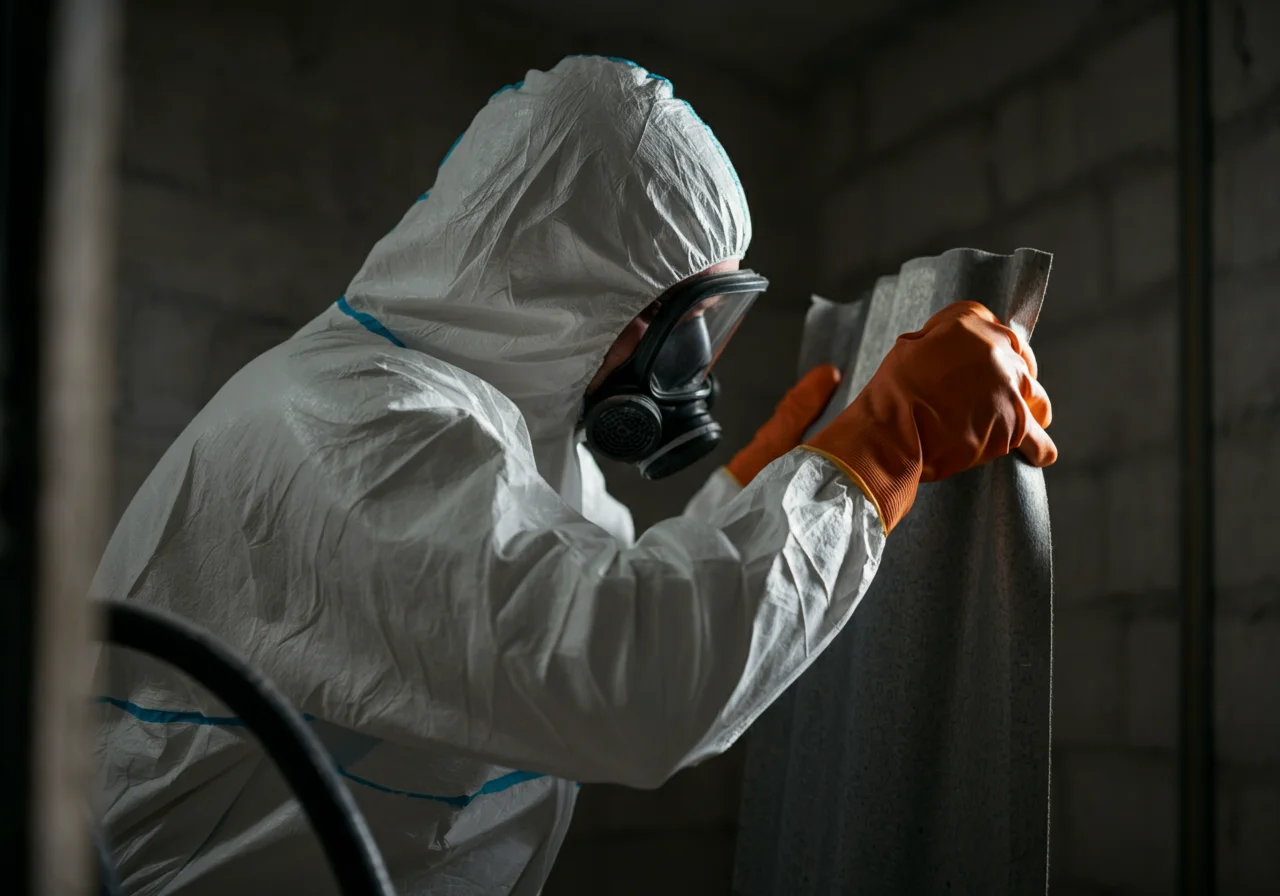
- Respiratory Protection: Abatement workers must use a fit-tested, half-face or full-face respirator with P100 (HEPA) cartridges.
- Wetting & Careful Removal: Material is kept saturated with amended water (water with a surfactant) during removal to suppress fibers.
- Waste Disposal: All asbestos waste must be sealed wet in 6-mil labeled bags and disposed of at a landfill permitted to accept regulated asbestos-containing material (RACM).
Code & Compliance: Regulatory Framework
Handling is governed by environmental and occupational safety regulations, not building codes. Key agencies and rules include:
- OSHA (Occupational Safety and Health Administration): Regulations 29 CFR 1926.1101 (construction) and 29 CFR 1910.1001 (general industry) set Permissible Exposure Limits (PELs), mandate training, and prescribe work practices, including the use of negative air pressure machines (HEPA-filtered air scrubbers) within containment.
- EPA (Environmental Protection Agency): The National Emission Standards for Hazardous Air Pollutants (NESHAP) rules (40 CFR Part 61, Subpart M) govern demolition and renovation activities, including notification requirements before work begins.
- State & Local Regulations: Often more stringent than federal rules. Most states require contractor licensing, specific training (e.g., Asbestos Handler certification), and detailed disposal tracking. Always check with your local environmental quality department.
Toolbox: Specialized Equipment for Professionals
Proper abatement requires specialized tools beyond standard trade equipment. Reputable brands in this space include:
| Tool/Equipment | Purpose | Example Brands/Notes |
|---|---|---|
| HEPA Negative Air Machine (Air Scrubber) | Creates negative pressure inside containment, filtering asbestos fibers from the air. | Abatement Technologies, Fluke (for air monitoring equipment). |
| P100 (HEPA) Respirator | Personal respiratory protection. Must be quantitatively fit-tested. | 3M, Moldex. Half-face for minor repairs, full-face PAPR for major projects. |
| 6-mil Polyethylene Sheeting | To create critical barriers and floor protection. | Generic, but must meet specific thickness and durability standards. |
| Asbestos Waste Bags & Labels | Legally required for disposal. Must be clearly marked with warnings. | Pre-printed, compliant bags from safety supply companies. |
Understanding the Health Risk: Mesothelioma
Mesothelioma is an aggressive cancer of the lining of the lungs, abdomen, or heart, almost exclusively caused by asbestos exposure. The latency period between exposure and diagnosis is typically 20-50 years. There is no safe level of exposure to asbestos fibers. When pipe insulation is cut, sanded, or broken, microscopic fibers become airborne and can be inhaled, lodging permanently in lung tissue. This is why “wet methods” and containment are non-negotiable safety procedures, not mere suggestions.
External References for Authority
For definitive information on regulations and health effects, consult these primary sources:
- OSHA Asbestos Standards: The complete regulatory text for construction and general industry. OSHA Asbestos Safety and Health Topics Page.
- EPA Asbestos Overview: Information for homeowners, schools, and professionals on regulations and proper handling. EPA Asbestos Home Page.
- National Cancer Institute – Mesothelioma: Authoritative medical information on the disease linked to asbestos exposure. NCI Mesothelioma Fact Sheet.
Final Professional Directive
Encountering asbestos in piping is a stop-work condition. Your responsibility is to identify the hazard, inform the client or site manager of the laboratory results, and ensure that all subsequent disturbance is performed by licensed, insured, and certified abatement professionals under full containment. Your expertise lies in recognizing the hazard and enforcing the protocol—not in becoming an untrained abatement worker. This approach protects your health, your license, and your liability.