License Renewal Steps
The Diagnosis: Maintaining an Active Master License Through Timely Renewal and CEU Tracking
For a professional plumber or HVAC technician, a master license is the cornerstone of your legal authority and business credibility. License renewal is not a simple administrative task; it is a mandatory, structured process defined by your state licensing board to ensure continued competency. The core technical challenge is the systematic tracking and verification of Continuing Education Units (CEUs)—the mandated educational credits required to keep your license in active status. Failure to accurately document and submit proof of CEU completion by the deadline results in license expiration, halting your legal ability to pull permits, perform work, and operate your business.
Technical Deep Dive: The Step-by-Step Renewal Protocol
Treat the renewal process with the same precision as a complex system installation. Missing a single step can cause a complete system failure—in this case, the loss of your license. Follow this procedural sequence.
- Step 1: Determine Your State’s Specific Requirements (90-120 Days Before Expiration)
- Locate your state’s licensing board website (e.g., “State Plumbing Board” or “Contractors State License Board”). This is your primary source of truth.
- Identify your exact renewal cycle (often 1-3 years), the expiration date, and the total number of CEUs required per cycle.
- Note the specific course content mandates. Most states require a mix of codes (IPC, UPC, NEC updates), technical review, and mandatory hours in topics like safety (OSHA 10), business law, or energy efficiency.
- Step 2: Source and Complete Approved Continuing Education
- Select providers approved by your state board. Common approved entities include trade unions (UA), industry associations (PHCC, ACCA), and accredited online learning platforms.
- Verify the provider’s approval number and that the course title matches an accepted category for your license type.
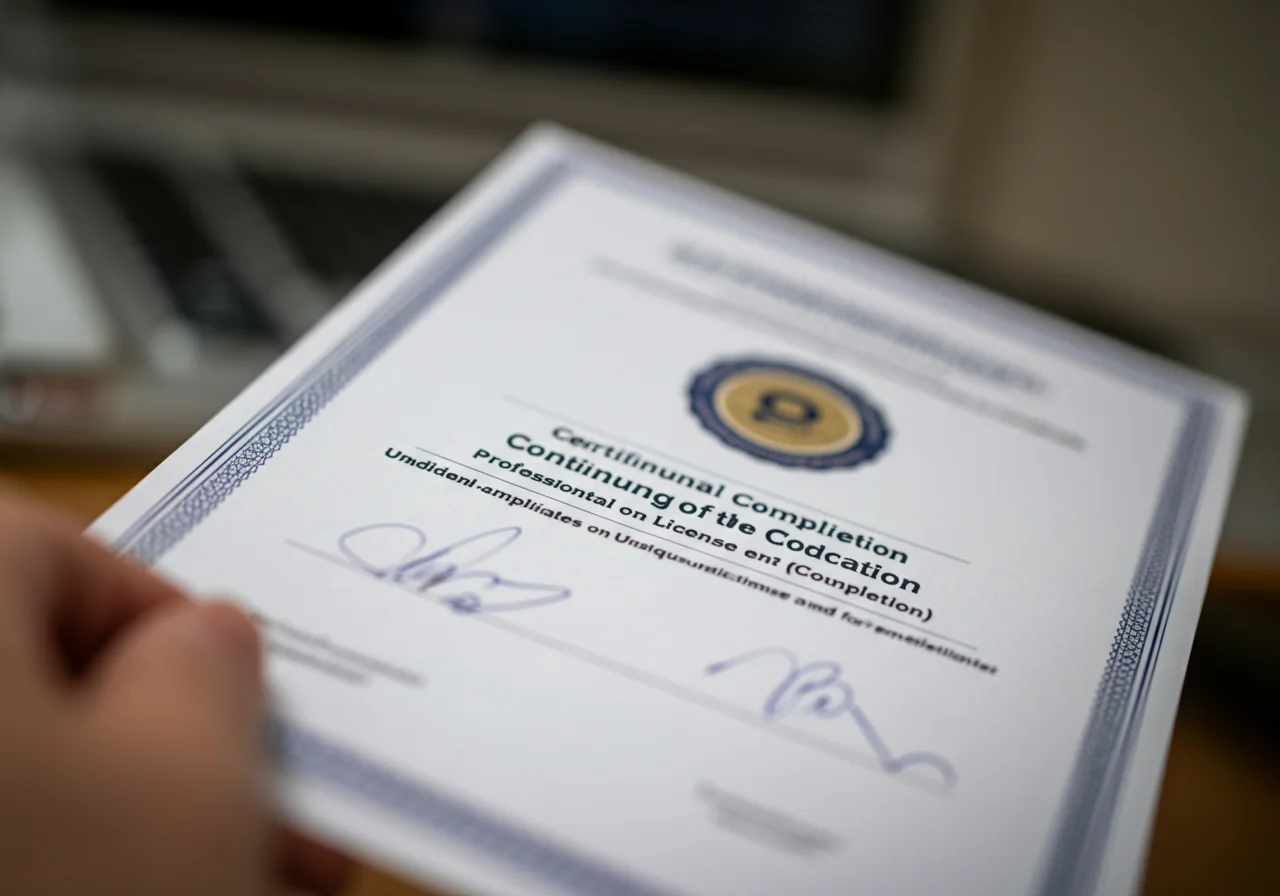
- Complete all courses, ensuring you receive a Certificate of Completion for each. This document is your proof of CEU.
- Step 3: Meticulous CEU Tracking and Recordkeeping
- Create a dedicated physical folder and digital scan for every certificate. A disciplined filing system is non-negotiable.
- Maintain a master log: Course Title, Provider Name/Approval #, Date Completed, Number of CEUs/Hours, and Certificate Number.
- Retain these records for a minimum of one full renewal cycle past your current one. Audits can occur retrospectively.
- Step 4: Execute the Renewal Application
- Complete the official renewal form from your licensing board, typically available online through their portal.
- Accurately input all required CEU information. For online renewals, you may need to input provider codes and course numbers.
- Pay the renewal fee via the board’s secure payment system. Keep the payment confirmation receipt.
- Step 5: Verification and Confirmation
- After submission, monitor your license status online. Do not assume success.
- Wait for and securely file the official renewal confirmation or new wallet card from the board.
- If you receive a deficiency notice (missing CEUs), respond immediately with your documented proof.
Code & Compliance: The Regulatory Framework
While licensing is state-specific, the underlying principles are governed by administrative law and reference uniform codes to ensure public health and safety.
- State Administrative Code: Your state’s rules, often titled “Licensing and Regulation of Plumbers” or similar, legally define the CEU requirements, renewal periods, and approved curriculum. This is the enforceable law.
- IPC & UPC References: Mandatory CEU courses frequently focus on changes to the International Plumbing Code (IPC) or Uniform Plumbing Code (UPC). Staying current with code editions (e.g., IPC 2021 to IPC 2024) is a common CEU requirement, as per IPC Chapter 1 (Administration) Section 106.6 and similar UPC sections, which grant the Authority Having Jurisdiction (AHJ) the power to require evidence of competency.
- OSHA Standards: Courses on OSHA 29 CFR 1926 (Construction) and 1910 (General Industry), particularly fall protection, confined space entry, and hazard communication, are often mandated CEUs to fulfill employer training requirements under federal law.
Toolbox: Essential Tools for License Management
Just as you rely on quality physical tools, use robust systems for license management.
| Tool Category | Purpose | Professional-Grade Examples |
|---|---|---|
| Digital Document Scanner | Create secure, searchable backups of all CEU certificates and board correspondence. | Fujitsu ScanSnap, Brother ADS series |
| Dedicated Cloud Storage | Off-site, encrypted storage for your license portfolio, accessible from any jobsite. | Google Drive, Microsoft OneDrive (with organized folder structure) |
| Calendar System with Alerts | Program critical deadlines: renewal date, CEU completion deadlines (e.g., 60 days prior). | Microsoft Outlook, Google Calendar (set multiple reminders) |
Safety Warning: The Critical Implications of an Expired License
WARNING: Performing licensed trade work with an expired license is illegal and carries severe consequences. It voids insurance coverage, exposes you to unlimited liability, and can result in fines, disciplinary action, and permanent marks on your professional record. Treat your renewal deadline with the same gravity as locking out a breaker before servicing a panel.
External References for Verification
Always cross-reference information with primary sources. For an overview of occupational licensing and its importance, you can review the U.S. Department of Labor’s perspective on licensing and certification. For the definitive rules, however, your state licensing board’s website remains the sole authoritative source.
Final Technical Note: Proactive management of your license renewal and Continuing Education transcript is a non-delegable responsibility of the master licensee. Implement a systematic tracking protocol, respect all deadlines, and maintain impeccable records. This discipline ensures uninterrupted authorization to practice your trade at the highest level.