Cleanout Requirements 2024
The Diagnosis: Defining Cleanout Requirements
Cleanout requirements are the codified rules governing the placement of access points in a drainage system to permit the clearing of obstructions. For 2024, the International Plumbing Code (IPC) remains the dominant standard, and its Chapter 7 provides the definitive framework. Failure to install cleanouts at mandated locations is a critical code violation that can lead to exorbitant repair costs, unsanitary conditions, and failed inspections. This guide details the mandatory locations for cleanouts in building drains and sewers, with a technical focus on sewer line access and rules at a change of direction.
Technical Deep Dive: IPC Chapter 7 Mandatory Locations
Compliance is not arbitrary. Each required cleanout location addresses a specific hydraulic or access challenge within the drainage system. Follow this step-by-step installation and verification protocol.
- Base of the Stack: A cleanout must be installed at the base of each soil or waste stack. This is the primary access point for servicing the vertical drain line and its horizontal branch connections. The cleanout must be the same size as the stack it serves, down to a minimum of 4 inches for stacks of 4 or more branch intervals.
- Building Drain/Sewer at the Exit: The sewer line access point is non-negotiable. A cleanout must be placed on the building drain or building sewer, outside the building structure, and within 5 feet of the foundation wall. This is the critical interface for rodding from the municipal sewer back into the private line.
- Change of Direction: This is a frequently misunderstood rule. A cleanout is required at each change of direction of the building drain or horizontal building sewer that is greater than 45 degrees (IPC 708.1). However, if the change of direction is 45 degrees or less, no cleanout is required at that fitting. For changes greater than 45 degrees, the cleanout must be installed at the junction of the two directions.
- Horizontal to Vertical Transitions: A cleanout is required at the junction of a horizontal drain line and a vertical stack, unless the horizontal drain is already provided with accessible cleanouts at intervals not exceeding 100 feet.
- Maximum Intervals: In long horizontal drainage piping (building drain or sewer), cleanouts must be installed at intervals not to exceed 100 feet. This is measured along the developed length of the pipe.
Code & Compliance: Citing the Authority
Your authority on the jobsite comes from knowing the code book. The following are direct citations from the 2021 IPC (the basis for most 2024-adopted codes).
| IPC Section | Requirement | Technical Rationale |
|---|---|---|
| 708.1 | Cleanouts required at base of each stack, at each change of direction greater than 45°, and at intervals not exceeding 100 ft. | Ensures a rodding entry point is never more than 100 ft from a blockage and can navigate major directional changes. |
| 708.3.1 | Cleanout size shall be the same size as the pipe up to 4 inches. For pipes 5 inches and larger, the cleanout may be one size smaller. | Maintains adequate cross-sectional area for tool passage and prevents creating a new obstruction point. |
| 708.4 | Cleanouts shall extend to grade, floor, or wall surface and be accessible. They shall not be concealed. | Accessibility is the entire purpose. Buried or sheetrocked cleanouts are non-compliant. |
| 708.5 | The building sewer cleanout shall be installed outside the building at or near the foundation wall or outside wall. | Provides the essential sewer line access for external servicing without entering the structure. |
Toolbox: Essential Gear for Installation and Service
Correct installation and future service depend on quality tools. For cutting and assembling cleanout fittings and pipe, a Ridgid threader for steel or a high-power reciprocating saw with diamond-grit blades for cast iron/Schedule 40 PVC is standard. For verification and service, a professional-grade Milwaukee M18 Drain Snake with appropriate cutter heads is required for lines 3″ and larger. Never use undersized or consumer-grade equipment on main building drains and sewers.
Safety Warning & Best Practices
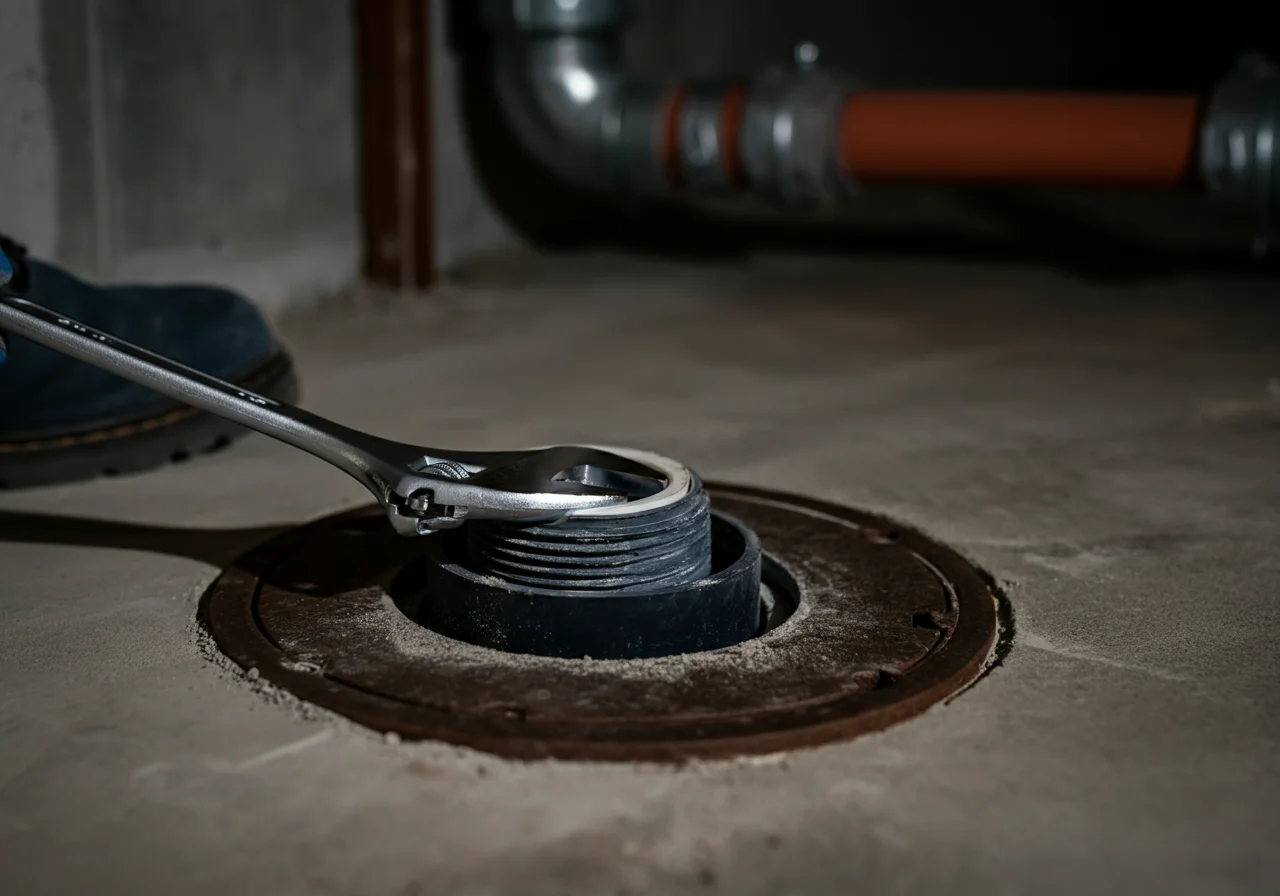
WARNING: Before attempting to open any existing cleanout plug for inspection or service, verify the entire drainage system is not under pressure or containing backed-up waste. Have spill containment ready. Always use the correct, sized wrench for cleanout plugs; using pipe wrenches on square-head plugs can round the corners, making future removal impossible. During new installation, ensure all cleanout plugs are hand-tight plus a quarter-turn—overtightening PVC plugs will crack the fitting.
External Reference for Definitive Specifications
For the most authoritative and detailed specifications on cleanout fittings, dimensions, and materials, always consult the manufacturer’s installation standards. The ASTM F477 standard for elastomeric gaskets is a critical reference for ensuring joint integrity on plastic piping cleanout assemblies, as cited by the IPC.
Advanced Application: Solving Common Field Problems
Beyond simple code listing, understanding the intent solves complex field problems.
Scenario 1: The 90-Degree Sweep in a Buried Sewer Line
A building sewer has a long-radius 90-degree elbow (a change of direction greater than 45°). Per IPC 708.1, a cleanout is required at this fitting. The correct installation is to use a 90-degree cleanout elbow fitting, or to install a straight cleanout tee in the horizontal run immediately before or after the elbow, oriented to allow rodding through the turn. Simply burying a standard 90 with no access is a violation.
Scenario 2: Multiple Changes of Direction Under a Slab
For building drains under a concrete slab, a cleanout is required at each change of direction >45°, and these cleanouts must be accessible. This typically requires installing vertical risers with screw-cap cleanouts that extend through the slab to a finished grade box or floor box. Planning the route to minimize unnecessary turns is not just good practice—it reduces mandatory cleanout points.
Scenario 3: Differentiating Building Drain vs. Building Sewer
The sewer line access rule specifically applies to the building sewer (the pipe from the house to the public sewer or septic tank). The cleanout at the foundation services this line. The building drain (the horizontal pipe inside the foundation that collects from all stacks) has its own rules for cleanouts at changes of direction and 100-foot intervals. Knowing where one ends and the other begins is crucial for proper cleanout requirements placement.
Final Authority: Always defer to the specific edition of the IPC (or UPC) adopted by your local jurisdiction, as amendments can occur. The inspector’s ruling is final. However, presenting an installation based on the clear, technical mandates of Chapter 7 demonstrates professional competence and is the hallmark of a senior tradesperson.