Confined Space Permit
The Diagnosis: Defining a Permit-Required Confined Space
A Confined Space Permit is a formal, written authorization mandated by OSHA for entry into a space that meets specific hazardous criteria. In commercial plumbing, HVAC, and mechanical work, failing to correctly identify and control these spaces is a leading cause of fatal incidents. The core of the issue is recognizing the difference between a “confined space” and a “permit-required confined space,” a critical distinction that triggers a rigorous set of safety protocols including continuous air monitoring and the assignment of a dedicated safety monitor.
Technical Deep Dive: The Identification and Entry Process
Identification is a systematic, three-step process. Do not proceed with any work until this assessment is complete and documented.
- Step 1: Is it a Confined Space? A space must have ALL three characteristics:
- Is large enough for an employee to bodily enter and perform work.
- Has limited or restricted means for entry or exit (e.g., manhole, access panel, small hatch).
- Is not designed for continuous occupancy.
Common examples in plumbing/HVAC: sewer manholes, septic tanks, large diameter pipes under construction, boilers, air handling unit plenums, and some equipment pits.
- Step 2: Does it Require a Permit? A confined space becomes permit-required if it has ONE or more of the following hazards:
- Contains or has the potential to contain a hazardous atmosphere.
- Contains a material that could engulf an entrant (e.g., water, sewage, granular material).
- Has an internal configuration that could trap or asphyxiate an entrant (inwardly converging walls, sloped floor).
- Contains any other recognized serious safety or health hazard (e.g., live electrical, steam lines, mechanical hazards).
- Step 3: Executing the Permit & Entry Procedures If the space is permit-required, the following system must be implemented before any entry:
- Permit Authorization: A qualified supervisor (the “entry supervisor”) completes and signs the permit, listing all known hazards, required precautions, authorized entrants, and the assigned safety monitor (attendant). The permit is valid only for the time required to complete the specific task.
- Atmospheric Testing & Continuous Air Monitoring: This is non-negotiable. Test for, in this order: Oxygen (19.5% – 23.5% is safe), Flammable gases (<10% of LEL), and then Toxic gases (like Hydrogen Sulfide or Carbon Monoxide). Use a calibrated, multi-gas monitor from a brand like Fluke or similar. Testing must be continuous during occupancy. Document all readings on the permit.
- Safety Monitor (Attendant) Role: This person remains outside the space, maintains constant visual/verbal contact with entrants, and never enters the space for rescue. Their sole duty is to monitor conditions and initiate the rescue plan by calling for professional emergency services if a hazard is detected.
- Mechanical Ventilation: Often required to maintain safe air quality. Use positive-pressure ventilation with the intake placed in clean air.
- Lockout/Tagout (LOTO): All hazardous energy sources (electrical, hydraulic, pneumatic, gravitational) must be isolated and locked out before entry.
Code & Compliance: The Legal Framework
This procedure is not a suggestion; it is federal law. The primary governing standard is OSHA 29 CFR 1910.146, “Permit-Required Confined Spaces.” For construction work, 29 CFR 1926 Subpart AA applies. While plumbing codes (IPC/UPC) govern the physical installation of systems that create these spaces (like manholes and tanks), the entry safety procedures are strictly OSHA’s domain. Local fire codes may also have additional notification requirements for rescue services.
| Hazard Type | OSHA Standard Threshold | Plumbing/HVAC Example |
|---|---|---|
| Oxygen Deficiency | < 19.5% | Decaying organic matter in a sewer manhole consuming oxygen. |
| Flammable Atmosphere | ≥ 10% of Lower Explosive Limit (LEL) | Methane gas accumulation in a septic tank or near a gas line. |
| Toxic Atmosphere (H2S) | ≥ 10 ppm (Ceiling) | Hydrogen Sulfide gas from sewage in a force main valve vault. |
Toolbox: Essential Equipment for Safe Entry
Using professional-grade, reliable equipment is critical. Do not rely on consumer-grade tools.
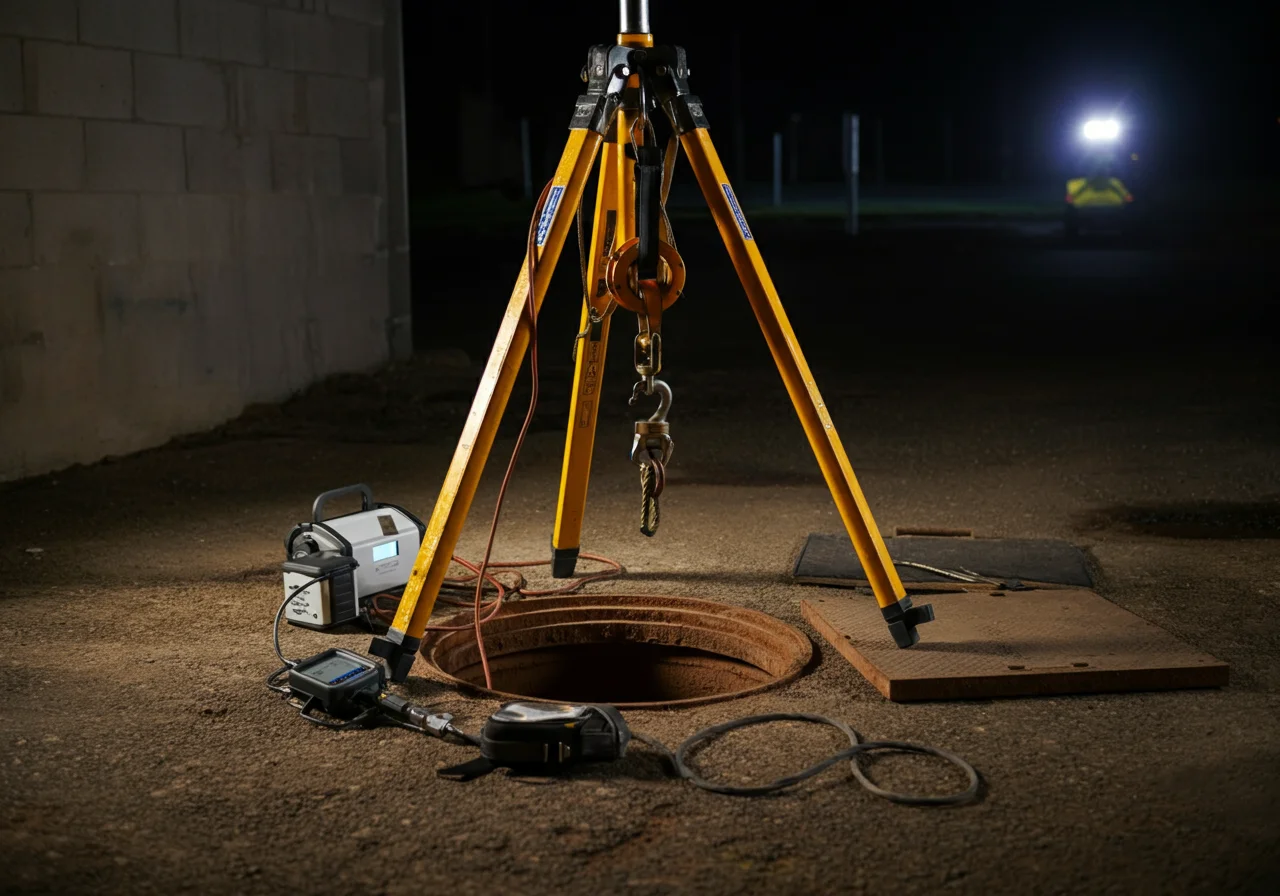
- Multi-Gas Monitor with Pump: For pre-entry and continuous air monitoring. Must be bump-tested and calibrated regularly. Example: Fluke branded monitors or equivalent industrial units.
- Mechanical Ventilation System: Electric or pneumatic blower with flexible ducting of sufficient CFM for the space volume.
- Tripod & Winch Rescue System: For vertical entries over 4 feet deep. A brand like Milwaukee offers robust tripod and hoist kits.
- Communication Equipment: Two-way radios or voice-activated hands-free systems for constant communication between entrant and safety monitor.
- Lighting: Explosion-proof, battery-operated lights for the entrant.
- Personal Protective Equipment (PPE): Full-body harness with retrieval line, appropriate respirator if needed (air-purifying or supplied-air).
Safety Warning
NEVER ENTER A SUSPECTED CONFINED SPACE WITHOUT PROPER ASSESSMENT AND TRAINING. Over 60% of confined space fatalities are would-be rescuers. Always assume a hazardous atmosphere exists until proven otherwise by calibrated instrumentation. Turn off and lock out all energy sources. The assigned safety monitor must never enter the space. Your rescue plan must involve calling 911 for professional, equipped rescue teams.
External Reference
For the definitive legal text and detailed compliance directives, always refer to the source: the U.S. Occupational Safety and Health Administration’s official page on Permit-Required Confined Spaces. This page contains the full standard, interpretive letters, and compliance assistance materials.