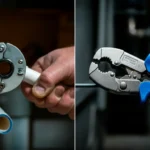
Deburring Tool Types
The Diagnosis: Internal Pipe Burrs Cause Turbulence, Leaks, and Void Warranties
A deburring tool is a non-negotiable final step in any pipe cutting operation. Failure to properly ream copper, PEX, or CPVC creates a sharp internal ridge, or burr, that acts as a restriction. This burr creates turbulence, increases pressure drop, generates flow noise (water hammer), and can shred O-rings in fittings, leading to premature failure. For the professional, skipping this step can void manufacturer warranties on valves and fixtures and violate plumbing code.
Technical Deep Dive: Tool Selection and Operation by Material
The correct deburring tool type is dictated by the pipe material and job site conditions. Using the wrong tool can be ineffective or damage the pipe.
1. For Copper Tubing (Type K, L, M)
- Tool: Standard Pipe Reamer (aka Wheel Reamer) or Deburring/Reaming Tool.
- Operation: After cutting with a tube cutter, insert the tapered reaming head into the pipe end. Apply moderate pressure and rotate clockwise. The goal is to remove the internal burr and create a slight 45-degree chamfer on the outer edge for easier soldering.
- Pro Tip: A quality reamer from Ridgid or Milwaukee will have hardened steel cutters and a debris chamber. Always clean out metal shavings before soldering.
2. For PEX Tubing
- Tool: PEX-Specific Deburring Tool or Go/No-Go Gauge Deburrer.
- Operation: PEX requires a different approach. The tool typically has a blade or hook that shaves the internal burr without removing significant material. Insert, rotate, and remove the thin plastic ring. This is critical for crimp and clamp ring systems to ensure a perfect seal.
- Pro Tip: For expansion PEX systems, deburring is equally vital to prevent the PEX ring from catching on a burr during installation.
3. For CPVC and PVC Schedule 40/80
- Tool: Chamfering Tool or Deburring Tool with a specific PVC blade.
- Operation: After saw-cutting, use the tool to bevel the outer edge for solvent weld joints. Remove any internal plastic strands to prevent them from lodging in valves.
Code & Compliance: It’s Not Just a Suggestion
Professional installations are governed by code, which explicitly mandates proper pipe end preparation.
- International Plumbing Code (IPC) 2021, Section 605.3: “Pipe shall be reamed or otherwise finished to full inside diameter.” This is a direct, enforceable requirement.
- Uniform Plumbing Code (UPC) 2021, Section 604.1: “All cut pipe ends shall be reamed to the full bore of the pipe.”
- Warranty Implications: Major valve manufacturers (e.g., Watts, Sloan) state in their installation instructions that pipe ends must be free of burrs. Failure to comply provides grounds for warranty denial on cartridge failures.
The Physics of Failure: Turbulence and Pressure Drop
An internal burr is a flow obstruction. As water passes this restriction, its smooth (laminar) flow breaks into chaotic, swirling turbulence.
| Consequence | Technical Explanation | Long-Term Impact |
|---|---|---|
| Flow Noise & Water Hammer | Turbulence creates a hissing or whistling sound. The sudden change in direction can also contribute to pressure surges (water hammer). | Annoyance to occupant; stress on pipe supports and fittings. |
| Reduced Flow Rate & Pressure | The burr acts as a fixed orifice, creating a permanent pressure drop (measured in psi loss) across every fitting. | Poor shower performance, slow-filling fixtures. |
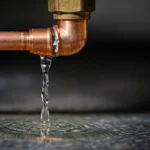
| Erosion-Corrosion | Microscopic cavitation bubbles form in the turbulent zone and implode against the pipe wall, slowly eroding the metal (in copper). | Premature pinhole leaks downstream of the burr. |
| Seal Failure | A sharp burr can cut or deform the rubber O-ring in a compression or push-to-connect fitting during assembly. | Leaks that may not appear immediately but develop over weeks/months. |
Toolbox: Essential Deburring Equipment
Investing in the right tool makes the step efficient and guarantees a correct result.
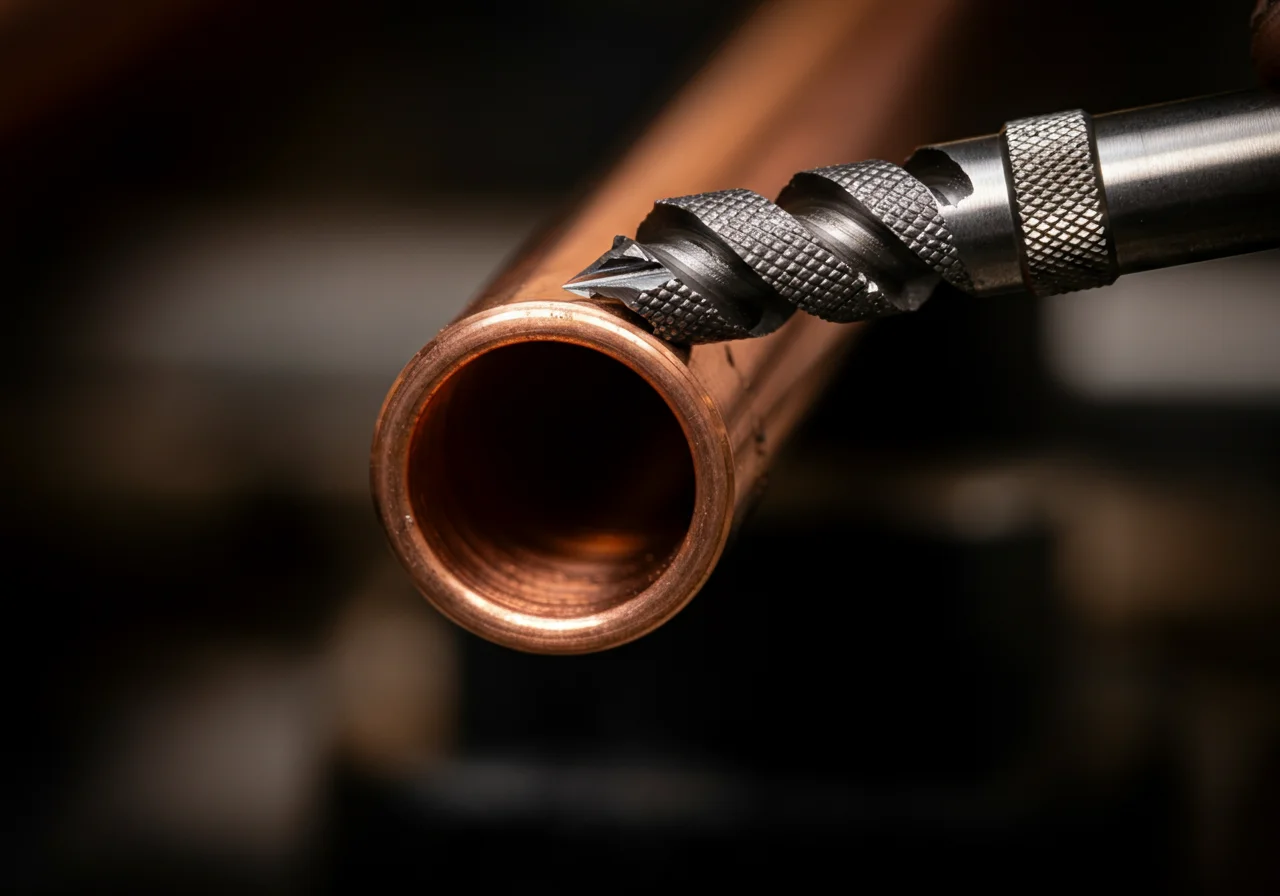
- Standard Pipe Reamer (Wheel Type): The classic for copper. Look for models with a built-in shavings catcher. (Example: Ridgid 32905).
- Multi-Tool Deburrer/Chamfer Tool: Often a 3-in-1 tool for deburring inside/outside and sizing PEX. Essential for service trucks.
- PEX Deburring Tool: A simple, inexpensive hook-style tool is mandatory for any PEX install. Do not use a copper reamer on PEX.
- Deburring Blade for Utility Knife: A fallback method, but less consistent and higher risk of personal injury. Not recommended for production work.
Safety Warning & Best Practices
SAFETY WARNING: Always wear ANSI-approved safety glasses when reaming. Metal and plastic shavings are ejected with force. For existing plumbing, confirm the water supply is OFF and the line is drained at a lower point before cutting. For electrical analog, use a non-contact voltage tester on nearby wiring.
Best Practice Protocol:
- Cut pipe square using the appropriate cutter (tube cutter for copper, plastic-specific cutter for PEX/CPVC).
- Select the correct deburring tool type for your material.
- Insert tool and apply firm, steady rotational pressure. 3-5 full rotations are typically sufficient.
- Invert pipe and tap out all debris. Visually and by feel inspect the ID for smoothness.
- Proceed with joining (sweat, crimp, glue, etc.).
External References
For the definitive standard on pipe sizing and fluid flow dynamics that underpin the importance of smooth bore, refer to the ASHRAE Handbook Fundamentals (Chapter 22: Pipe Sizing). This is the engineering reference for system design that codes are based upon.