Hydro Jetter Nozzle
The Diagnosis: Nozzle Selection is 90% of the Job
A hydro jetter nozzle is not a universal tool. It is a precision-engineered component that converts high-pressure water into a specific cleaning action. Selecting the wrong nozzle for a given clog type—be it a grease blockage or root cutting—results in wasted time, incomplete cleaning, and potential damage to the pipe. This guide provides the technical criteria for matching nozzle type to obstruction.
Technical Deep Dive: Nozzle Types and Applications
The two primary categories for drain line cleaning are penetrating nozzles (forward jet) and spinning nozzles (rotary jet). Their design dictates their function.
1. Penetrating Nozzles (Forward Jet)
Designed for breaking through solid blockages and pushing the hose forward. They feature one or more rear-facing jets (for propulsion) and a single, powerful forward-facing jet.
- Primary Use: Initial penetration of heavy blockages, compacted debris, and sediment.
- Jet Configuration: Typically one forward jet (0°), 2-4 rear jets (25-40°).
- Action: The forward jet blasts a hole through the clog, allowing the hose to advance. The rear jets provide thrust.
- Tool Tip: Use a Milwaukee or Ridgid jetter unit capable of at least 3,000 PSI and 4 GPM for effective penetration in 3″-4″ lines.
2. Spinning Nozzles (Rotary Jet)
Designed for cleaning the pipe wall after penetration. They feature multiple side-facing jets set at an angle to induce rotation.
- Primary Use: Scouring pipe walls of grease, scale, and root hairs; final cleaning.
- Jet Configuration: 2-8 side jets (15-90°), often with varied angles on the same head.
- Action: Water pressure causes the nozzle to spin rapidly, creating a scouring, sandblasting effect along the entire pipe circumference.
- Tool Tip: For consistent spin, ensure your machine provides stable pressure. A Fluke pressure gauge on the output can verify performance.
| Clog Type | Recommended Nozzle Type | Jet Angle & Count | Pressure (PSI) / Flow (GPM) Focus | Objective |
|---|---|---|---|---|
| Grease Blockage (FOG) | Spinning Nozzle (Aggressive Scour) | 4-8 jets, 15°-45° & 90° combination | High Flow (5+ GPM) to emulsify and evacuate | Shear grease from walls and flush it downstream. |
| Root Mass / Taproot | Penetrating Nozzle, then Root Cutter Spinner | Penetrator: 1 forward, 3 rear. Cutter: 2-4 side, 0°-15° | High Pressure (3,500+ PSI) to cut and shred | Puncture root ball, then cut/grind remaining fibers. |
| Scale & Mineral Buildup | Spinning Nozzle (Abrasive Scour) | 3-5 jets, 25°-90° | High Pressure (4,000+ PSI) | Fracture and dislodge hardened deposits. |
| General Debris / Sediment | Standard Spinning Nozzle | 3-5 jets, 35°-50° | Balanced Pressure & Flow | Scour and flush loose material. |
Specific Application: Grease Blockage Protocol
Fat, Oil, and Grease (FOG) adheres to pipe walls. Removal requires shearing force and high-volume evacuation.
- Step 1 – Initial Assessment: Camera inspection to confirm FOG accumulation and rule out a total blockage.
- Step 2 – Nozzle Selection: Use a multi-jet spinning nozzle with a combination of 15°-25° jets for aggressive scouring and 90° jets for forward thrust. Avoid pure penetrators, as they will tunnel through the grease without cleaning the walls.
- Step 3 – Machine Settings: Prioritize flow rate (5-8 GPM) over extreme pressure (2,500-3,500 PSI is often sufficient). The goal is to emulsify and flush.
- Step 4 – Technique: Work the nozzle slowly back and forth, allowing the spinning jets to scour the entire circumference. Multiple passes are typical.
Specific Application: Root Cutting Protocol
Roots require a two-stage attack: penetration followed by cutting/grinding.
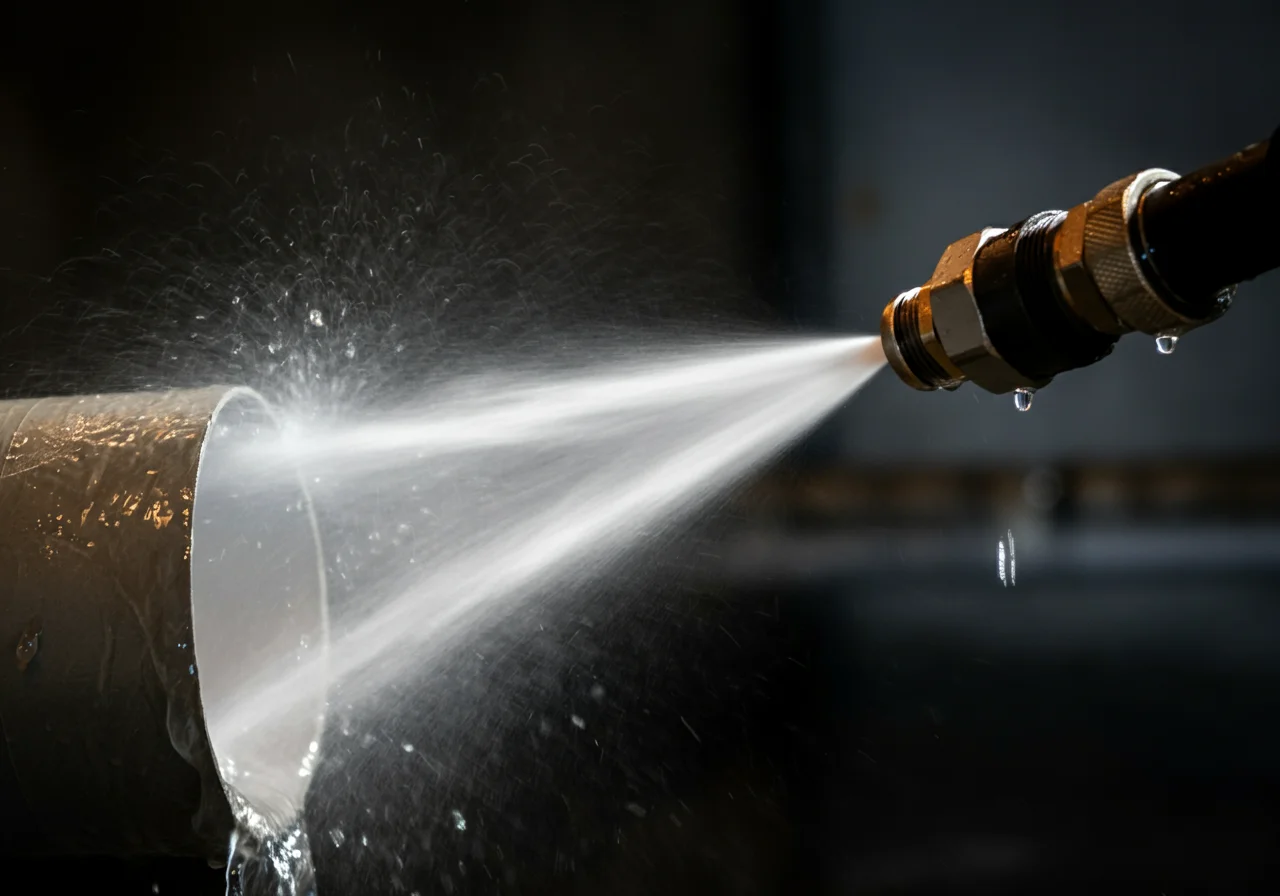
- Step 1 – Initial Penetration: Use a pointed penetrating nozzle to blast through the main root mass and reach the full length of the blockage.
- Step 2 – Root Cutting: Switch to a dedicated root cutting nozzle. These are spinning nozzles often with chisel-tipped or carbide jets designed to shred and grind root fibers.
- Step 3 – Machine Settings: Maximum pressure is critical (3,500-5,000 PSI). Flow supports evacuation (4-6 GPM).
- Step 4 – Technique: After penetration, run the root cutter slowly from the end of the line back to the cleanout. The rapid spin and focused jets will reduce roots to a slurry.
- Step 5 – Final Clean: Follow with a standard spinning nozzle to flush all debris and clean the pipe walls.
Code & Compliance
While nozzle selection isn’t directly code-prescribed, the work performed must meet plumbing code standards for pipe integrity and system function.
- IPC 712.1 / UPC 712.1: “Drain, waste, and vent piping shall be installed to maintain a slope of not less than 1/4 inch per foot…”. Hydro jetting must restore the pipe to its original capacity and slope by removing all obstructions.
- OSHA 1926.302(b)(4): “All hoses exceeding 1/2-inch inside diameter shall have a safety device at the source of supply or branch line to reduce pressure in case of hose failure.” This mandates the use of a trigger gun and proper hose ratings.
- Best Practice: Post-cleaning camera inspection is considered industry standard for verifying code compliance (clean, unobstructed pipe).
⚠️ Safety Warning: Mandatory Protocol
1. Pressure Integrity: Always inspect the nozzle, hose, and couplings for wear, cracks, or leaks before each use. A failed component at 4,000 PSI can cause severe injury.
2. PPE: Wear ANSI-approved safety glasses, face shield, waterproof gloves, steel-toe boots, and hearing protection.
3. Workspace Safety: Secure the hose feed area. Never stand over or directly behind the hose or cleanout during operation. Use a trigger gun with a deadman switch.
4. Utility Awareness: Verify pipe material and condition via camera prior to jetting. High pressure can damage old clay, Orangeburg, or corroded cast iron.
Toolbox: Essential Gear
- Hydro Jetting Machine: Select a unit with variable pressure (2,000-5,000 PSI) and flow (3-8 GPM) control. (e.g., Ridgid KJ-3100 series).
- Nozzle Kit: A professional kit includes multiple penetrators, spinners, root cutters, and a chain knocker for navigating 90° bends.
- Inspection Camera: Mandatory for pre- and post-work verification. Confirms clog type and cleaning result.
- Hose & Fittings: Use manufacturer-specified high-pressure hose (e.g., 4,000 PSI working pressure) with swivel fittings to prevent hose whip.
External Reference
For an in-depth engineering perspective on high-pressure waterjet technology and cutting dynamics, which directly applies to nozzle design, refer to the technical overview from the Occupational Safety and Health Administration (OSHA) on Pressure Washer Hazards. This document reinforces the critical safety principles required when operating hydro jetting equipment.