OSHA Trench Safety
OSHA Trench Safety: The Non-Negotiable Protocol for Every Excavation
OSHA Trench Safety is the system of regulations and protective measures designed to prevent cave-ins, the leading cause of fatalities in excavation work. Compliance is not optional; it is a life-saving requirement for any trench 4 feet or deeper. This guide details the critical protocols for shoring, benching, and safe access that every competent person and crew must enforce on-site.
The Diagnosis: Understanding the Cave-In Hazard
A trench is a narrow excavation where the depth exceeds the width. Soil is heavy and unstable; one cubic yard can weigh over 2,500 pounds. A collapse occurs without warning, burying and crushing workers in seconds. The primary defense is a protective system—sloping, shoring, or shielding—implemented before anyone enters.
Technical Deep Dive: Implementing Protective Systems
The choice of protective system depends on soil classification, depth, water content, and site conditions. A “competent person” must conduct daily and condition-changing inspections to classify soil and select the appropriate method.
1. Soil Classification (The First Critical Step)
- Type A: Cohesive soils like clay. Unconfined compressive strength of 1.5 tons per square foot (tsf) or greater.
- Type B: Cohesive soils like angular gravel or silt. Unconfined compressive strength between 0.5 and 1.5 tsf.
- Type C: Granular soils like sand or gravel. Unconfined compressive strength of 0.5 tsf or less. This is the most hazardous.
Visual-Tactile Test: A competent person performs tests such as the thumb penetration test or uses a penetrometer to classify soil accurately.
2. Protective System Options (OSHA 1926 Subpart P)
For trenches 5 feet deep or more, a protective system is required. For trenches 4 feet or more, a safe means of egress is required within 25 lateral feet.
| System | Description | Application & Key Specs |
|---|---|---|
| Sloping & Benching | Cutting back the trench wall at an angle to prevent collapse. |
Simple benching (creating horizontal levels) is allowed only in Type A and B soil under specific, controlled conditions. |
| Shoring | Installing aluminum hydraulic or timber shores to support trench walls. |
|
| Shielding (Trench Boxes) | Using a protective structure to guard workers if a collapse occurs. |
|
3. Mandatory Safe Access and Egress
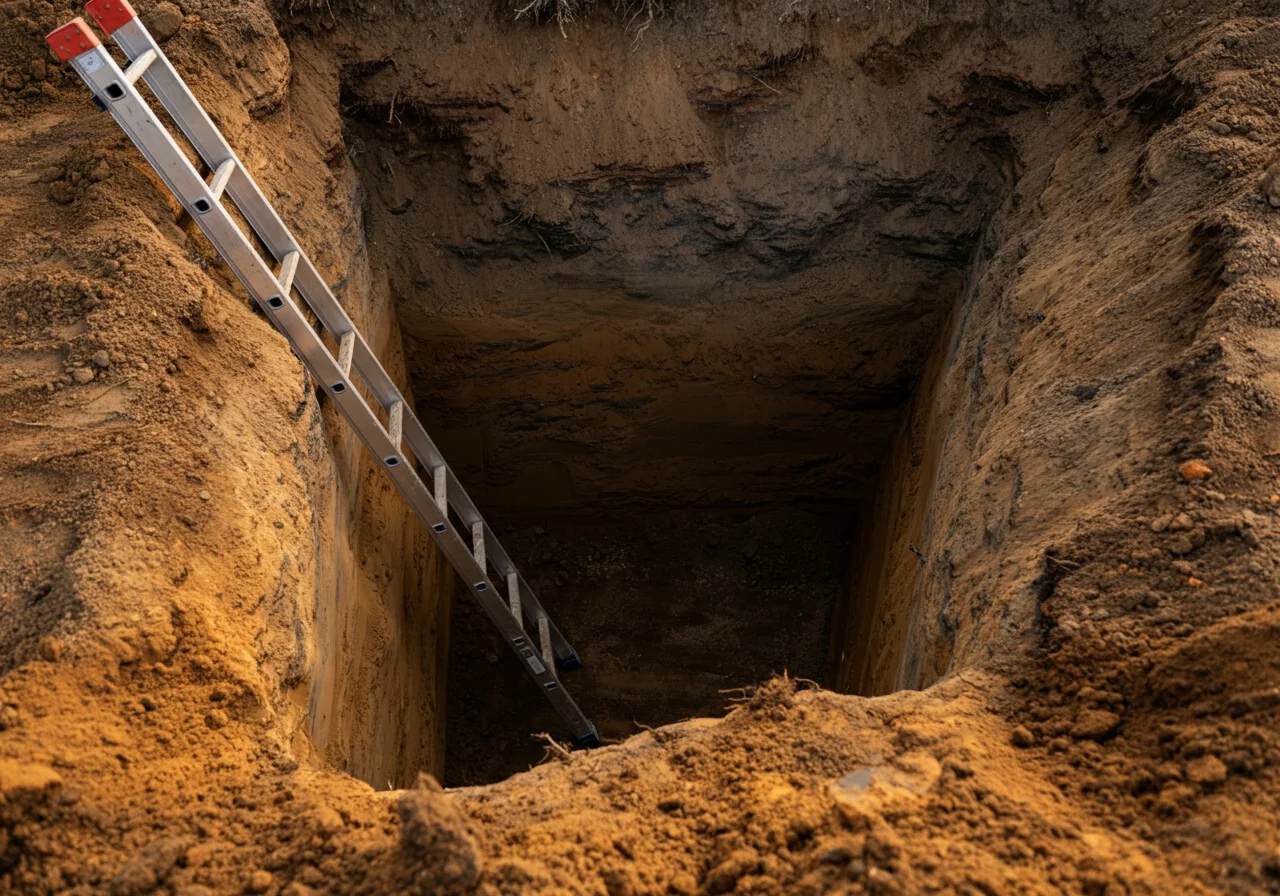
OSHA 1926.651(c) is unequivocal: In trenches 4 feet or deeper, a ladder, stairway, or ramp must be provided and located so no worker is more than 25 feet from an exit.
- Ladders: Must extend at least 3 feet above the trench lip, be secured at top and bottom, and be on a firm base.
- Ramps: For equipment access, must have a slope no steeper than 1:1 (45°).
Code & Compliance: The Regulatory Backbone
All guidelines are enforced under OSHA 29 CFR 1926 Subpart P – Excavations. Key citations include:
- 1926.651(b): Requires daily inspections by a competent person.
- 1926.652(a)(1): Mandates protective systems for trenches 5 feet or deeper.
- 1926.652(b): Provides the specific requirements for sloping and benching configurations.
- 1926.652(c): Covers requirements for timber, aluminum hydraulic, and other shoring systems.
Failure to comply can result in willful or repeat citations with penalties exceeding $150,000 per violation.
Toolbox: Essential Gear for Compliance
Beyond shoring equipment, the competent person’s kit must include:
- Testing Equipment: Penetrometer, pocket shear vane, or soil sampling tools for classification.
- Inspection Tools: A Fluke laser distance measure for checking trench depth and slope angles, and a robust tape measure.
- Atmospheric Tester: A 4-gas monitor to check for low oxygen, flammable gases, and toxic fumes in confined spaces.
- Shoring Systems: Hydraulic shores from manufacturers like Speed Shore or GME, used strictly per their tabulated data.
Safety Warning: The Non-Negotiables
⚠️ CRITICAL: NEVER enter an unprotected trench 5 feet or deeper. Soil has no warning signs before failure. Always assume the hazard is present. Spoil piles and other loads must be kept at least 2 feet back from the trench edge. Ensure utilities are located and marked (call 811) before any digging begins. A competent person must inspect the site after every rain event or any other change in conditions.
External Reference for Authoritative Data
For the definitive regulatory text and official interpretations, always refer to the source:
OSHA Standard 1926 Subpart P – Excavations. This .gov page contains the complete legal requirements, appendices with detailed soil mechanics, and approved protective system designs.
Final Takeaway: OSHA Trench Safety is a binary condition—the trench is either 100% compliant or it is lethally dangerous. There is no middle ground. The competent person holds the ultimate responsibility for identifying hazards, selecting the correct protective system, and stopping work until it is safe. In excavation, protocol is protection.