Plumbing Liability Insurance
The Diagnosis: Defining Plumbing Liability Insurance
For a professional plumbing contractor, Plumbing Liability Insurance is not an optional business expense; it is a foundational risk management tool. This coverage is a specialized suite of policies designed to protect your business assets and financial stability from the significant liabilities inherent in the trade. The core risks—third-party bodily injury, property damage (especially water damage), and professional mistakes—can lead to catastrophic financial losses without proper coverage. This guide details the essential technical components of a robust insurance portfolio for a plumbing business.
Technical Deep Dive: Core Coverage Components
A complete plumbing liability insurance program is built on two primary pillars, each addressing distinct categories of business risk.
1. Commercial General Liability (CGL) Insurance
This is your first line of defense against claims arising from your business operations. It covers third-party claims for bodily injury and property damage.
- Coverage Trigger: Typically covers “occurrences” — accidents that happen during the policy period, regardless of when the claim is filed.
- Key Scenarios Covered:
- A client or visitor slips on a wet floor from your work area and is injured.
- Your employee accidentally damages a client’s finished drywall, cabinetry, or flooring while accessing a pipe.
- Subcontractor injury on your job site where you may be held liable.
- Water Damage Specifics: CGL is critical for sudden and accidental water damage. For example, if a newly-soldered joint fails and floods a client’s home, the policy would cover the cost to repair the damaged drywall, flooring, and personal property. It generally does not cover the cost to re-do your faulty workmanship itself.
2. Professional Liability / Errors & Omissions (E&O) Insurance
This policy covers financial losses a client suffers due to your professional advice, design, or workmanship. It fills the gap left by CGL.
- Coverage Trigger: Covers “claims-made” events — the claim must be made and reported to the insurer during the active policy period.
- Key Scenarios Covered:
- You design a drainage system that fails to meet local code (IPC/UPC), causing chronic backups and property damage.
- You incorrectly size a boiler or water heater, leading to system failure and loss of use for the client.
- A client sues you for negligence after a repair fails, even if no immediate property damage occurred (e.g., a leak that develops slowly behind a wall).
- The Workmanship Gap: While CGL covers the resultant water damage from a burst pipe, E&O would cover the cost to diagnose, remove, and re-install the faulty section of pipe—the repair of your own professional error.
Code & Compliance: Insurance as a Contractual Requirement
Carrying adequate insurance is often mandated by law, code, and contract.
- Licensing: Most state contractor licensing boards require proof of General Liability insurance as a condition for obtaining and renewing a plumbing contractor’s license.
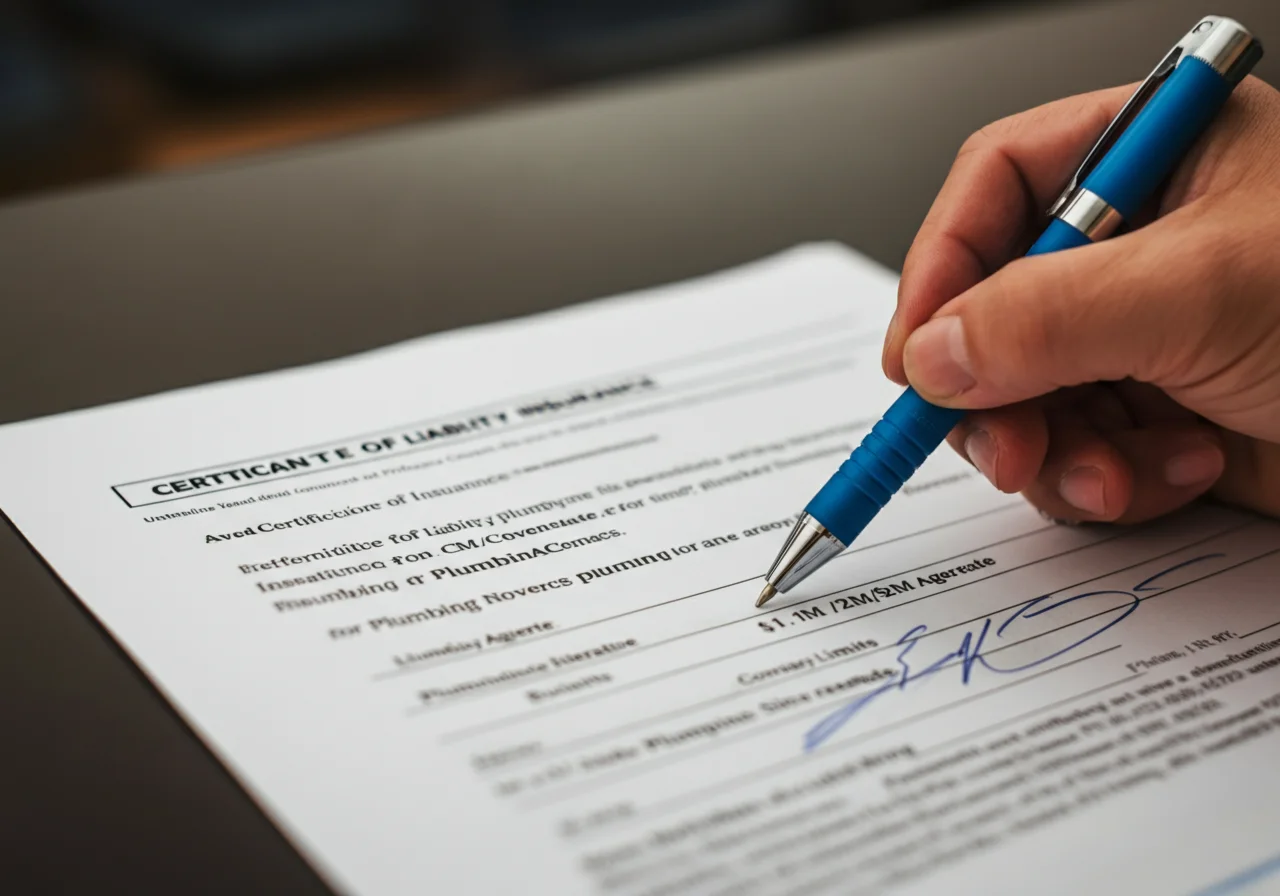
- Contractual Obligations: General contractors, property management firms, and commercial clients will require you to provide a Certificate of Insurance (COI) naming them as an “additional insured” before you can step on a job site. This is a standard risk-transfer mechanism.
- OSHA & Workplace Safety: While not directly requiring liability insurance, OSHA (Occupational Safety and Health Administration) fines for violations can be substantial. Proper insurance helps ensure your business can survive such financial hits and continue funding safety programs. Information on employer responsibilities can be found on the official OSHA website.
Toolbox: Managing Your Business Risk
Just as you rely on quality tools like Milwaukee pipe cutters and Ridgid threaders for physical work, managing financial risk requires precise tools and documentation.
| Risk Management Tool | Purpose | Action Item |
|---|---|---|
| Detailed Service Agreements | Define scope of work, limitations, and client responsibilities. Helps defend against scope-creep claims. | Use a standardized contract reviewed by an attorney. |
| Job Documentation | Photos, videos, and notes pre- and post-work. Proves condition and your professional process. | Use a digital field service app; store files permanently. |
| Subcontractor Verification | You can be held liable for a sub’s work. Ensure they carry their own GL and Workers’ Comp. | Collect and verify COIs from all subs before they begin work. |
| Inland Marine (Tool) Insurance | Covers your mobile business property (e.g., van inventory, Fluke multimeters, pro-press tools) against theft or damage off-premises. | Schedule high-value items separately on your policy. |
Policy Specifications and Endorsements
When reviewing a quote, these are critical technical specifications to verify:
- Occurrence vs. Claims-Made: Understand which form your CGL uses. “Occurrence” is generally preferred for long-tail risks like latent water damage.
- Per-Project Aggregate Endorsements: For large jobs, this endorsement ensures the full policy limit is available for that single project, rather than being shared across all jobs.
- Pollution Liability: May be needed if you handle chemical drain cleaners, fuel oil lines, or backflow prevention where contamination is a risk.
- Completed Operations Coverage: Included in standard CGL. This is the part that covers you for claims that arise after you have finished the job and left the site.
External Reference for Foundational Knowledge
Understanding basic insurance principles is key to selecting the right policy. For a clear, neutral definition of core concepts like liability and risk pools, you can refer to the Wikipedia entry on Insurance. Always cross-reference this with guidance from your professional agent.
Final Technical Note: Your plumbing liability insurance is as integral to your business as a code-compliant installation. It must be correctly sized (adequate limits), properly installed (with the right endorsements), and regularly inspected (annual policy reviews). Neglecting this system exposes your business to a single-point failure that no tool warranty can fix.