Rusty Hot Water Causes
The Diagnosis: Rusty Hot Water
Rusty hot water is a definitive sign of corrosion within your plumbing system. For a professional, the immediate diagnostic task is to isolate the source: is the corrosion internal to the water heater tank itself, or is it originating from the distribution piping? The two primary culprits are glass lining failure due to a depleted anode rod and corrosion of old galvanized steel piping. Accurate diagnosis prevents unnecessary replacement and targets the correct repair.
Technical Deep Dive: Source Isolation Procedure
Follow this systematic, step-by-step diagnostic to pinpoint the origin of the rust contamination.
Step 1: Initial Assessment & Safety
- Safety First: Turn off the power to an electric water heater at the breaker panel. For a gas unit, set the thermostat to “Pilot” or “Off.” Shut off the cold water supply valve to the heater.
- Observe Patterns: Is the rust present only at hot water faucets? Does it clear after running the water for a minute, or is it constant? Rust primarily from hot water strongly points to the heater or its immediate hot outlet line.
Step 2: The Hot Water Heater Drain Test
This is the conclusive test for tank integrity.
- Connect a standard garden hose to the tank’s drain valve and run it to a floor drain or outside.
- Open a hot water faucet in a nearby sink to break vacuum.
- Open the drain valve fully and collect several gallons in a white bucket.
- Diagnosis: If the water is consistently rusty or contains visible sediment/glass lining flakes, the tank is actively corroding. Clear water suggests the tank lining may still be intact.
Step 3: Inspect the Anode Rod
The anode rod is a sacrificial magnesium or aluminum core rod that protects the steel tank. Its depletion is the direct cause of glass lining failure.
- Locate the anode rod’s hex head, typically on the top of the tank (sometimes under a plastic cap).
- Use a 1-1/16″ deep socket (Ridgid or Milwaukee impact-rated sockets are excellent for this high-torque application) and a long breaker bar to loosen it. Warning: This can be extremely tight.
- Withdraw the rod and inspect. A fully depleted rod will be less than 1/2″ in diameter, heavily corroded, or may have nothing left but the steel core wire.
Step 4: Check Distribution Piping
If the tank test is clear, the galvanized piping is suspect.
- Trace the first 3-6 feet of hot water pipe out of the heater. Galvanized pipe has a dull gray, crystalline appearance and will often show external rust at threaded joints.
- For a more advanced test, use a Fluke multimeter set to DC Volts to check for stray electrical grounding. Place one probe on a copper cold water pipe and the other on the suspected galvanized hot water pipe. A reading above 0.5V can indicate accelerated galvanic corrosion.
Code & Compliance
Adherence to plumbing codes is not just about installation; it governs materials and practices that prevent corrosion.
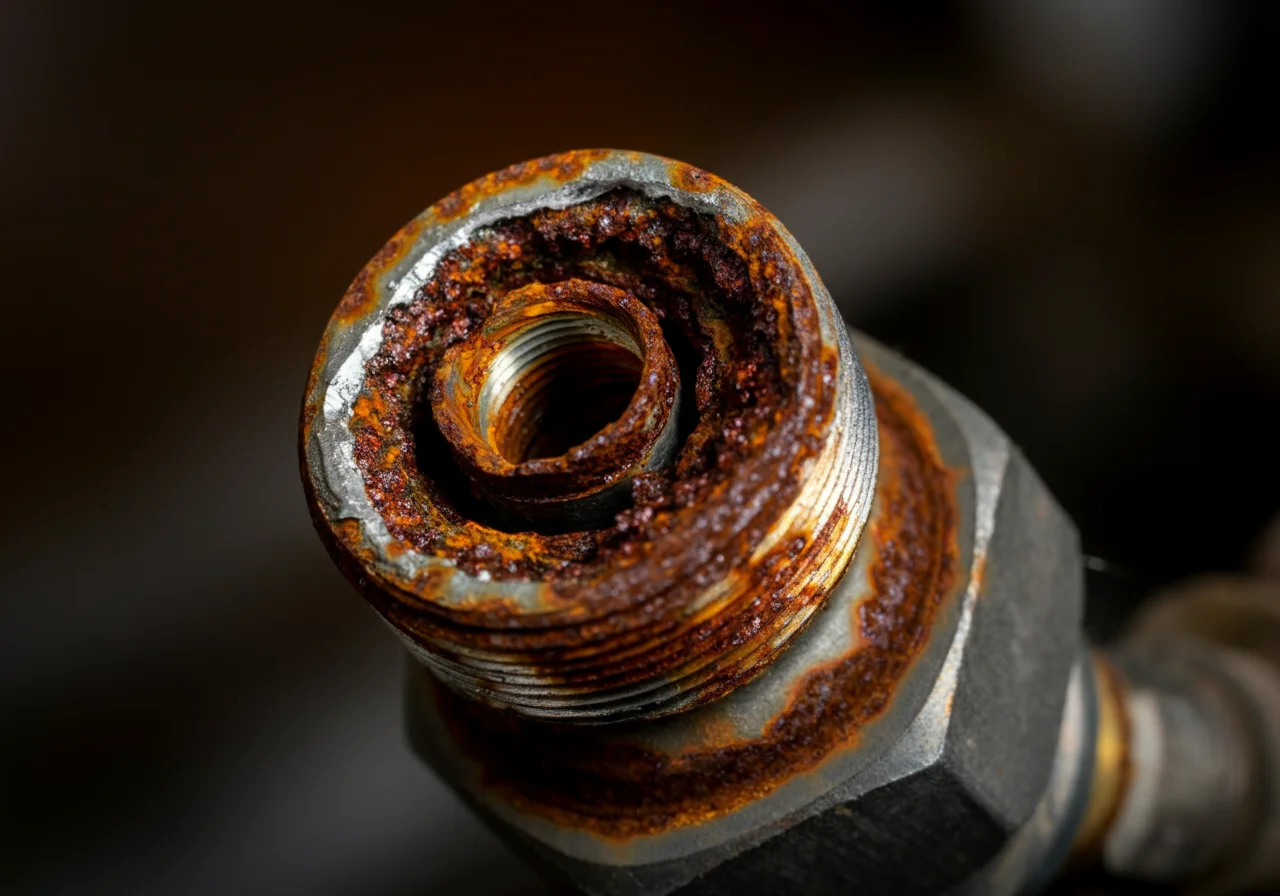
- Dielectric Unions/Waterways (IPC 605.3.1 / UPC 605.3): Code mandates the use of dielectric separation when connecting dissimilar metals (e.g., copper to galvanized steel). Missing or failed dielectric unions are a prime cause of accelerated pipe corrosion.
- Anode Rods (Manufacturer Code): While not explicitly in the IPC/UPC, manufacturer installation instructions (which are code-recognized) require the anode rod to remain installed and functional for the warranty to be valid. Its inspection is a recognized maintenance standard.
- Galvanized Pipe (IPC 605.4.2): The code notes galvanized steel’s susceptibility to internal corrosion over time, implicitly favoring more corrosion-resistant materials like copper, CPVC, or PEX for potable water.
Toolbox for Diagnosis & Repair
| Tool | Purpose | Example Brand |
|---|---|---|
| 1-1/16″ Deep Socket & Breaker Bar | Anode rod removal | Milwaukee, Ridgid |
| Digital Multimeter | Checking for galvanic corrosion voltage | Fluke |
| Pipe Wrenches (2) | Replacing dielectric unions or piping | Ridgid |
| 5-Gallon White Bucket | Collecting drain water for visual inspection | Generic |
Understanding the Core Failure Mechanisms
Anode Rod Depletion & Glass Lining Failure
The steel tank is lined with a porcelain glass coating. This coating is not perfect; it has microscopic fissures. The anode rod (magnesium or aluminum) is electrically more “active” than steel. In the water’s electrolyte, it sacrifices itself via electrolysis, protecting the tank. Once the anode is fully consumed, the electrolytic process attacks the exposed steel at the lining’s imperfections, causing tank rust. The rust you see is the steel tank itself corroding.
Galvanized Pipe Corrosion
Galvanized pipe is steel coated with zinc. Over decades, the zinc coating erodes, exposing the base steel to water and oxygen. This process accelerates with hot water and in areas with aggressive (low pH) water. Internal rust scale builds up and flakes off with flow, appearing at fixtures. The problem is often worst after periods of stagnation (e.g., first thing in the morning).
External Reference
For a detailed scientific explanation of the electrolytic (cathodic) protection provided by anode rods, refer to the technical principles outlined by the National Association of Corrosion Engineers (NACE). This resource provides the foundational engineering standards behind the technology in your water heater.